Meteors, the ISS, and the Night Sky: What Really Happens When Orbital Paths Cross a Shooting Star Storm
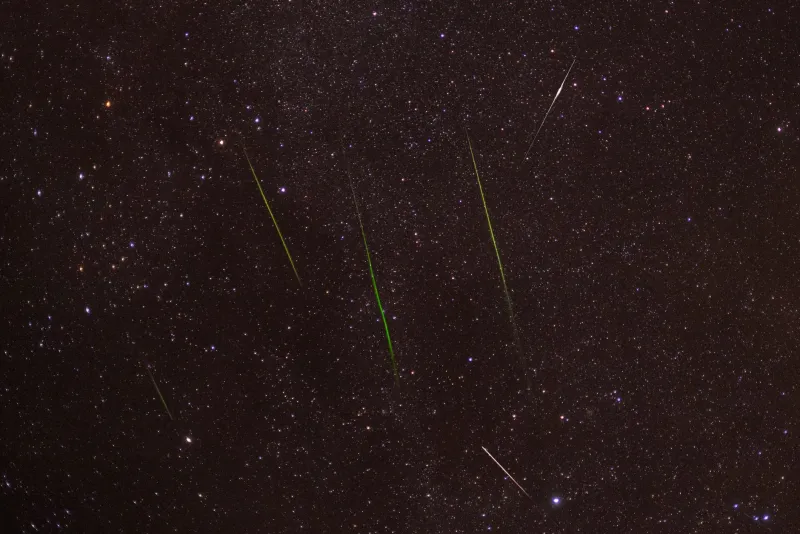
Picture this: It's mid-August, you're flat on your back in a lawn chair, and the Perseids are doing their annual thing overhead. Streaks of light every few minutes, the occasional fireball, the whole show. Then your tracking app buzzes — the ISS is inbound. For the next ninety seconds, a 925,000-pound orbital laboratory is going to arc across the same patch of sky that's currently raining cosmic debris.
So what actually happens when those two events collide?
The honest answer is more complicated — and more interesting — than most people expect.
Two Events, Two Very Different Altitudes
Here's the first thing worth understanding: when you see a meteor during a shower like the Perseids or the Leonids, that streak of light isn't happening anywhere near the ISS. Meteors become visible when tiny fragments of comet debris slam into Earth's upper atmosphere, typically between 50 and 80 miles above the ground. The ISS, by comparison, orbits at roughly 250 miles up.
That gap matters enormously. By the time those incoming particles reach meteor-burning altitude, they've already done most of their cosmically dramatic work. The ISS sits well above the atmospheric friction zone where meteors put on their light show. So from a pure visual standpoint, if you're watching both the ISS pass and a meteor shower simultaneously, you're actually watching two completely separate layers of the sky perform at the same time — not one unified event.
Think of it like watching a fireworks display from the 50th floor of a building while a street performer does tricks on the sidewalk below. Same general direction, wildly different elevations.
What an Observer on the Ground Actually Sees
For backyard astronomers in the US, the visual overlap of an ISS pass during a meteor shower peak is genuinely fun to catch — even if the physics keeps the two phenomena miles apart. The station's steady, satellite-bright track across the sky provides a useful reference point. If a meteor happens to streak across the ISS's path at the same moment, the contrast is striking: one object gliding silently and predictably, the other burning fast and chaotic.
Some observers have reported seeing meteors appear to "cross" directly in front of or behind the ISS during a pass. That's a perspective trick — the meteor is burning up far below the station's orbit — but the visual effect can be genuinely jaw-dropping. It's one of those moments that makes you feel the actual three-dimensional depth of the sky in a way that's hard to manufacture artificially.
If you want to maximize your chances of seeing both events in the same viewing window, tools like NASA's Spot the Station or apps that overlay meteor shower radiant points with satellite passes are your best bet. Timing matters. The Perseids peak in the pre-dawn hours, which also tends to produce the most favorable ISS geometry for US observers at certain latitudes. Planning both into a single night session isn't just possible — it's genuinely worth the extra prep.
The Real Collision Question: Does the ISS Get Hit?
Now for the part that sounds alarming but is actually more nuanced than the headlines suggest.
Yes, the ISS operates in an environment where micrometeoroids — tiny fragments moving at extraordinary speeds — are a real engineering concern. The station is built with that in mind. Its Whipple shielding, a layered system of bumper panels and pressure walls, is specifically designed to absorb impacts from particles up to about a centimeter in diameter. Anything larger gets tracked by the Space Surveillance Network, and NASA can maneuver the station if a collision risk crosses certain thresholds.
During active meteor showers, does that risk go up? Technically, yes — but not by nearly as much as you might think. Most shower meteors that reach Earth's atmosphere are extraordinarily small, often no bigger than a grain of sand. At orbital altitudes, the density of those particles is still relatively low compared to the background micrometeoroid environment the ISS deals with every single day. The station isn't flying through a blizzard during the Perseids. It's more like a slight uptick in an already-present drizzle.
NASA does monitor shower activity and factors it into risk assessments. There have been cases where EVAs — spacewalks — were scheduled to avoid peak shower windows when particle flux was projected to be elevated. That's not panic; that's just good engineering housekeeping.
Why Shower Peaks and ISS Passes Rarely Sync Up the Way You'd Hope
Here's the frustrating orbital reality for observers hoping to plan the perfect combined viewing night: the ISS doesn't care about meteor shower schedules.
The station completes roughly 15.5 orbits per day, and its visibility from any given location on the ground depends on the angle of sunlight, your latitude, and the station's current orbital inclination. Meteor shower peaks, meanwhile, are dictated entirely by when Earth's orbital path intersects the debris trail left by a particular comet. Those two scheduling systems operate on completely independent logic.
Some years, the ISS will pass over your backyard at exactly the right time during the Geminids. Other years, peak activity happens during a window when the station is in Earth's shadow or simply below your horizon. There's no reliable annual alignment. When it does happen to sync up, treat it as a bonus — not something you can count on.
That said, during any active shower period spanning several nights, the odds of at least one decent ISS pass coinciding with reasonable shower activity are pretty solid. You don't need to catch the absolute peak hour. Even moderate activity — ten to fifteen meteors per hour — combined with an ISS transit makes for a compelling observing session.
Making the Most of a Combined Sky Night
If you're planning a night that chases both events, a few practical suggestions go a long way.
First, set up facing the meteor shower's radiant point, but give yourself enough peripheral vision to catch the ISS track without having to spin around. A wide reclining chair or a blanket on the ground works better than a fixed telescope for this kind of multi-target night.
Second, check your local ISS pass times early in the day and compare them against the shower's predicted peak window. If you're in the continental US, NASA's Spot the Station tool and apps like Heavens-Above both let you filter by visible passes above a certain brightness threshold. Aim for passes rated at magnitude -2 or brighter — those are the ones that cut through light-polluted suburban skies without much trouble.
Finally, give your eyes at least twenty minutes to dark-adapt before either event. It sounds basic, but it's the single most impactful thing you can do to improve what you actually see.
The sky doesn't usually hand you perfectly choreographed moments. But when a steady orbital machine slides across a canvas already lit up by ancient comet dust, it's a reminder of just how many layers of physics are operating overhead every single night — whether or not your app gives you a notification about it.