Escape the Glow: Finding Dark Sky Spots Near US Cities for Your Best-Ever ISS Views
Here's a scenario that plays out constantly across the country: your tracking app pings you, the ISS is incoming at magnitude -3.5, you step outside, look up — and the station crawls across a sky the color of a lit parking garage. It's visible, sure. But it's not impressive. It's not the kind of thing you'd call someone out of bed to see.
Light pollution did that. And it's worse than most people realize.
What Light Pollution Actually Does to Your Sky
Artificial light scatters off water vapor, dust, and aerosols in the atmosphere, creating a dome of diffuse brightness above populated areas. This is called sky glow, and it doesn't just dim the stars — it compresses the dynamic range of everything you see overhead. The ISS is bright enough to cut through moderate light pollution, but the visual contrast that makes a pass genuinely stunning — the station blazing against a truly dark backdrop — disappears almost entirely.
On the Bortle scale, which astronomers use to measure sky darkness from 1 (pristine dark) to 9 (inner-city glare), most American suburbs sit between 6 and 8. At those levels, you can see the ISS, but you're missing a significant chunk of what the experience can offer. Drop to a Bortle 4 or lower, and the same pass looks like a completely different event.
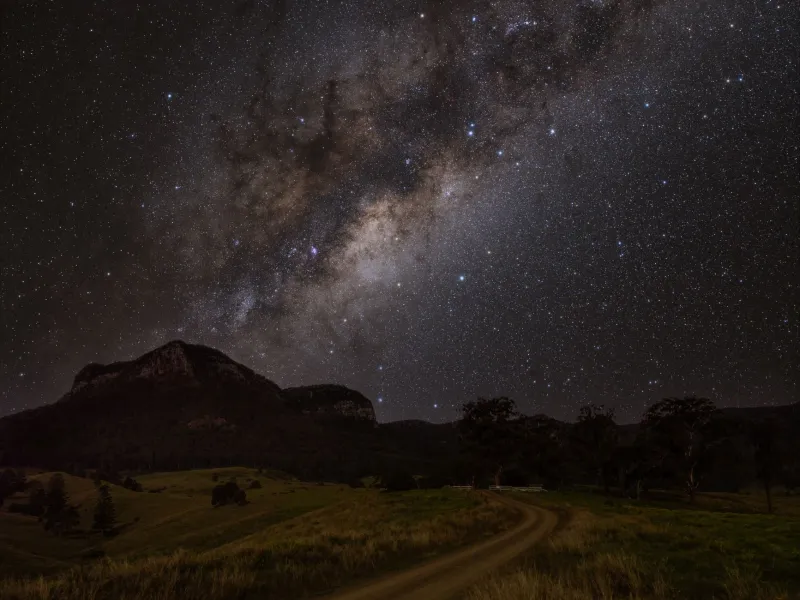
For context: at Bortle 4, the Milky Way is clearly visible. The sky has actual texture. And the ISS doesn't just move — it streaks.
Finding Your Nearest Dark Sky Escape
The good news is that genuine dark-sky territory is closer to most US cities than people assume. You don't need to plan a week-long camping trip to the desert. A two-hour drive can often get you from a Bortle 7 suburb to a Bortle 4 hillside.
Use Light Pollution Maps. The best starting point is lightpollutionmap.info, which overlays satellite-measured sky brightness data on a zoomable map. Type in your city, zoom out until you see darker zones (look for green, blue, or grey shading rather than red and orange), and start identifying candidate locations. You're looking for spots that are accessible by road, have an open view of the sky, and aren't in the path of incoming headlights.
Check the IDA Database. The International Dark-Sky Association maintains a list of officially designated Dark Sky Parks, Reserves, and Communities across the US. There are currently over 190 IDA-certified locations in the country, and they're distributed across nearly every state. Many are attached to state or national parks, meaning they're maintained, accessible, and often have flat open areas perfect for observation.
A few standouts worth knowing about:
- Cherry Springs State Park, Pennsylvania — one of the darkest spots east of the Mississippi, about four hours from Philadelphia and New York City
- Big Bend National Park, Texas — a certified International Dark Sky Park with some of the best skies in the lower 48
- Headlands International Dark Sky Park, Michigan — remarkably accessible from Detroit and Chicago, with organized viewing areas
- Enchanted Rock State Natural Area, Texas — dark skies within two hours of Austin and San Antonio
- Natural Bridges National Monument, Utah — the first IDA-certified park in the world, still one of the best
If none of those are near you, don't worry. Even un-certified dark zones — rural county roads away from town centers, reservoir edges, national forest access points — can offer dramatically improved skies.
Timing Your Trip Around ISS Passes
Here's where the planning gets fun. You're not just picking a dark location — you're coordinating that location with an ISS pass worth watching.
Start by pulling up pass predictions for your target dark-sky site specifically, not your home address. Tracking apps like ISS Detector and Heavens-Above let you set any location as your viewing point. Enter the coordinates of your chosen spot and look for passes with a maximum elevation above 40 degrees and a magnitude brighter than -2. Those are your targets.
Also consider the moon. A full moon can wash out even a dark-sky site, raising effective sky brightness by several Bortle levels. Plan your dark-sky trips around new moon windows — the week before and after new moon offers the best combination of darkness and manageable logistics.
And don't forget twilight. The ISS is only visible when it's in sunlight and you're in darkness — typically the hour or two after sunset and before sunrise. The geometry shifts seasonally, but summer evenings and winter mornings often produce the longest, most dramatic passes.
The Bigger Picture: Why Dark Skies Matter Beyond the ISS
Chasing better ISS views is a great reason to seek out dark skies. But once you're out there under a genuinely dark sky, something else tends to happen: the universe shows up.
The Andromeda Galaxy becomes visible to the naked eye. The Milky Way resolves from a vague glow into an actual structure. Satellites you didn't know existed start appearing. Your sense of scale — of what's actually up there — fundamentally shifts.
This is what light pollution costs us culturally, not just scientifically. Roughly 99% of Americans live under light-polluted skies. A generation is growing up without ever having seen the Milky Way. The ISS is one of the most accessible entry points to genuine astronomical wonder — but it's being experienced through a filter of artificial brightness that mutes everything.
Organizations like the International Dark-Sky Association and DarkSky America are fighting to preserve what's left. Supporting dark-sky ordinances in your municipality, switching to properly shielded outdoor lighting, and simply advocating for the issue in your community are all meaningful actions.
Before You Go
A few practical notes for your first dark-sky ISS trip:
- Arrive early. Give your eyes 20-30 minutes to dark-adapt before the pass. Avoid white flashlights — use red light only.
- Dress for it. Even summer nights get cold when you're standing still in a field. Bring layers.
- Confirm the pass time on-site. Cellular data can be spotty in rural areas. Download your pass predictions before you leave home.
- Tell someone where you're going. Basic safety practice for any remote-area outing.
The ISS is up there every night. The difference between watching it from your driveway and watching it from a dark-sky site is the difference between hearing a symphony through a wall and sitting in the front row. Make the drive. You won't regret it.