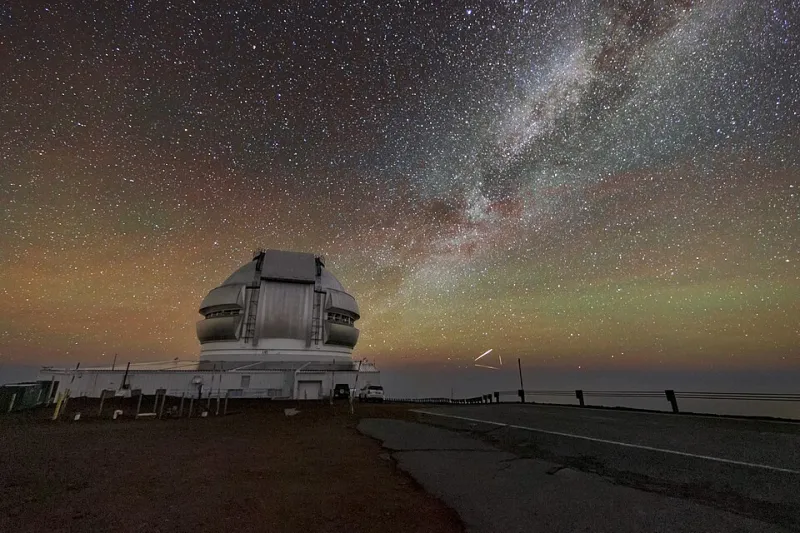
Your Backyard, the ISS, and the Clock That Never Quite Repeats Itself
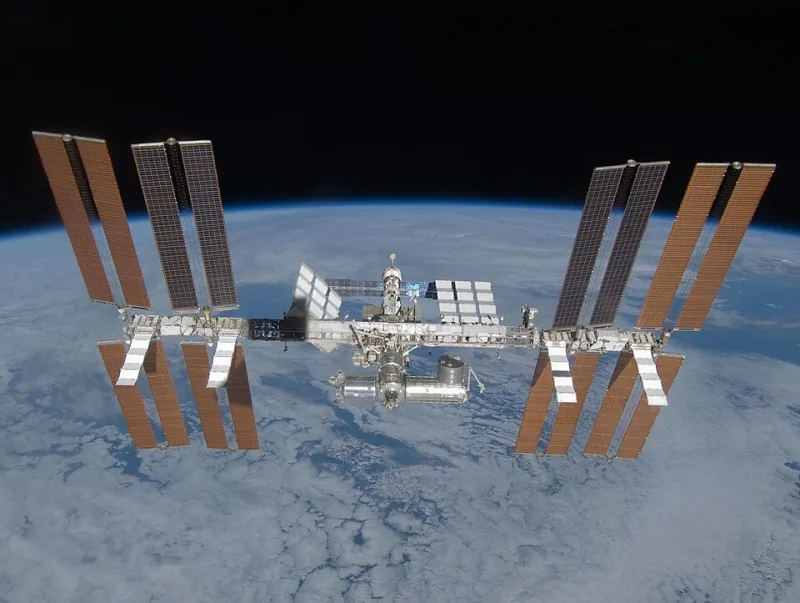
Photo: National Aeronautics and Space Administration (Q23548), Public domain, via Wikimedia Commons
There's something almost magical about spotting the International Space Station arc silently across a clear night sky. No blinking lights, no engine noise — just a steady, brilliant point of light cruising from horizon to horizon in under six minutes. But if you've tried to make a habit of watching it, you've probably noticed something frustrating: it doesn't show up on the same schedule two nights in a row. Some weeks it's practically a nightly visitor. Other times it disappears for days. What gives?
The answer isn't random. It's actually a beautiful little lesson in orbital mechanics, and once it clicks, you'll have a serious edge when it comes to planning your next sighting.
The ISS Is Moving Way Faster Than You Think
Let's start with the basics. The International Space Station orbits Earth at roughly 17,500 miles per hour, completing a full lap around the planet every 90 minutes or so. That means the crew up there sees about 16 sunrises and sunsets every single day. For us on the ground, it means the station's position relative to your backyard is constantly shifting — and not in a neat, predictable loop.
Here's the key thing to understand: Earth is rotating underneath the ISS the whole time. So while the station is busy lapping the planet, your hometown is spinning eastward at roughly 1,000 mph (depending on your latitude). Every time the ISS completes one orbit, Earth has rotated about 22.5 degrees to the east. That shift means each successive pass traces a slightly different ground track — moving westward relative to Earth's surface with each orbit.
Over the course of a day, those passes gradually march across different parts of the country. One orbit it's passing over the Pacific Northwest. A few orbits later, it's crossing the Midwest. By the end of the day, the geometry has shifted enough that the station might not be visible from your specific location at all — at least not during nighttime hours.
The Visibility Window Problem
Here's where it gets a little more nuanced. Spotting the ISS isn't just about whether it's flying overhead. You need three things to line up at once: the station has to be above your horizon, it has to be in sunlight (so it reflects light you can see), and your sky has to be dark enough that the reflected sunlight actually stands out.
That last condition — darkness — is the real wildcard. The ISS orbits at about 250 miles up, which means sunlight hits it even when your local sky is already twilight or full dark. But if it passes directly overhead at noon, you'll never see it. The sweet spot is roughly the hour or two after sunset and before sunrise, when you're in darkness but the station is still catching the sun.
As the weeks roll by and Earth continues its annual journey around the sun, the geometry of those twilight windows shifts. Some months you'll get a string of excellent evening passes. Then the station will seem to vanish for a week or two before popping back up in the pre-dawn sky instead. It's not ghosting you — it's just physics.
Why the Timing Shifts Throughout the Month
There's one more layer to this puzzle, and it's tied to the ISS's orbital inclination. The station orbits at about 51.6 degrees inclination, meaning it swings between roughly 51 degrees north and south latitude. Combined with the constant westward drift of its ground track, this creates a repeating but never-identical pattern of passes for any given location on Earth.
A full cycle — where the ground tracks start to roughly repeat — takes about 3 days. But "roughly" is doing a lot of work in that sentence. Atmospheric drag, occasional altitude-boosting maneuvers, and the natural wobble of the orbit all nudge the timing around. Think of it less like a train schedule and more like a tide chart: there's a pattern, but the exact numbers change constantly.
The upshot for you as an observer in, say, Columbus, Ohio or Tucson, Arizona: the ISS might be perfectly positioned for a high, bright overhead pass on a Monday evening, then offer only low-horizon passes for the next few days, then disappear into daylight geometry entirely before cycling back into good evening viewing a week or two later.
How to Actually Predict Passes From Your Location
Okay, enough theory — let's talk tools. The good news is you don't need to do any of this math yourself. Several excellent free resources will crunch all those orbital parameters and hand you a precise schedule for your exact address.
NASA's Spot the Station (spotthestation.nasa.gov) is the most straightforward option. Pop in your city or zip code and you'll get a list of upcoming passes with times, duration, and maximum elevation. Elevation matters a lot — a pass that only reaches 10 degrees above the horizon is often blocked by trees or buildings, while anything above 40 degrees is typically a great show.
Heavens-Above (heavens-above.com) goes deeper, offering sky charts that show the exact path the ISS will trace across your sky for each pass. It's a bit more technical-looking but incredibly useful once you get the hang of it.
ISS Detector and ISS Spotter are solid mobile apps for iOS and Android that send you push notifications before upcoming passes — genuinely handy when you don't want to check a website every day.
For any pass, pay attention to the magnitude rating. The ISS can hit around -5 or -6 at its brightest, which makes it outshine everything in the sky except the moon. A pass rated at magnitude -3 or brighter is worth setting an alarm for.
Tips for Getting the Most Out of Your Sighting
A few practical notes from experience: Give your eyes at least 10 minutes to dark-adapt before the pass, especially if you've been staring at your phone. Step outside a minute or two early — the station moves fast, and you don't want to miss the first half while you're fumbling with the door.
Note the direction it appears from and the direction it's heading, since the prediction tools will tell you both. And if you're in a light-polluted area like a major metro, aim for passes with a high maximum elevation — those tend to be bright enough to punch through the glow.
Finally, if you catch a particularly long, bright pass, try binoculars. You won't resolve much detail, but on the best nights you can make out that the ISS isn't just a dot — it has a shape. That elongated smudge is a 356-foot-wide structure hosting a crew of humans, moving at five miles per second, and your backyard is the perfect seat to watch it go.