A Sky Full of Satellites: How Megaconstellations Are Dimming the Future of Astronomy
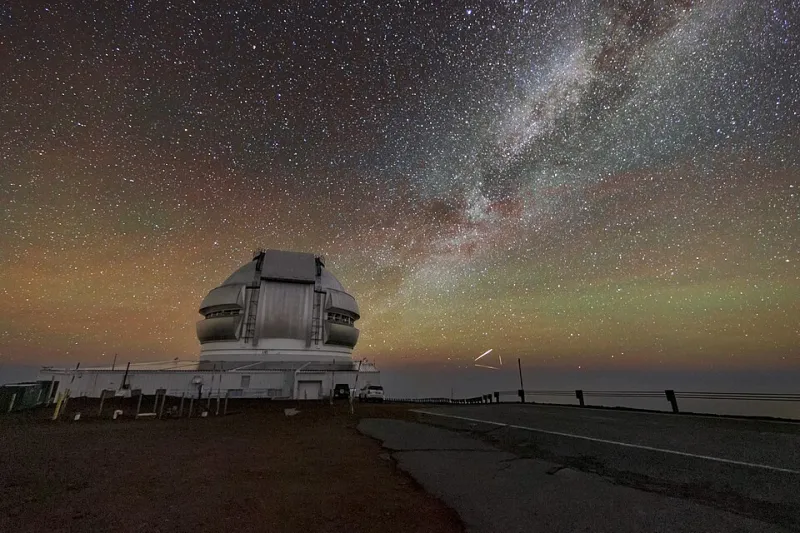
Photo: International Gemini Observatory/NOIRLab/NSF/AURA/J. Pollard, CC BY 4.0, via Wikimedia Commons
On a clear night away from city lights, the sky above you looks much as it did to Galileo — vast, dark, and full of possibility. But spend enough time watching, and you'll start to notice something Galileo never had to deal with: a slow parade of moving lights, one after another, marching in near-perfect formation across the stars. Those aren't UFOs. They're satellites, and there are more of them up there every single month.
We're living through the early stages of what the aerospace industry calls the megaconstellation era — a period in which private companies are deploying not dozens but thousands of satellites into low Earth orbit simultaneously. SpaceX's Starlink network already has over 6,000 active spacecraft in orbit and has approval to launch tens of thousands more. Amazon's Project Kuiper is ramping up. OneWeb, Telesat, and others are staking their own orbital claims. By some projections, the total number of active commercial satellites could exceed 100,000 by the mid-2030s.
For astronomers — both professional and amateur — this isn't just an inconvenience. It's an existential threat to how humanity has studied the cosmos for centuries.
What Satellites Actually Do to Astronomical Observations
To understand the problem, it helps to picture what a satellite looks like through a telescope. From the ground, a Starlink satellite in low Earth orbit appears as a bright streak across a long-exposure image — a white slash cutting right through whatever galaxy, nebula, or asteroid a researcher was trying to capture. Depending on the satellite's altitude and the time of night, it can be bright enough to completely overexpose part of a sensor.
For casual stargazers, this is annoying. For professional observatories running automated sky surveys, it's a genuine scientific crisis. The Vera C. Rubin Observatory in Chile — a flagship US-funded project designed to photograph the entire visible sky every few nights — has estimated that without mitigation, Starlink satellites could affect a significant percentage of its images during twilight hours. Twilight is precisely when many near-Earth asteroid searches happen to be most effective.
The issue isn't just streaks, either. Radio astronomers face interference from satellite communication signals bleeding into sensitive frequency bands. Infrared observatories deal with thermal signatures. Even the collective glow of thousands of satellites contributes to a form of artificial sky brightness that dims the contrast of the night sky for everyone below.
Astronomers Push Back — Loudly
The scientific community has not taken this quietly. The International Astronomical Union has issued formal statements of concern. The American Astronomical Society has convened working groups and published detailed impact assessments. Individual researchers have gone public with frustration that feels, at times, barely contained.
"We didn't get a vote," one astronomer put it bluntly at a recent conference, summarizing a sentiment shared widely in the field. Ground-based observatories represent decades of public investment and scientific infrastructure — and the orbital environment they depend on is being reshaped by corporate decisions made without meaningful regulatory oversight or community input.
In the US, the Federal Communications Commission grants orbital licenses and spectrum access to satellite operators. Critics argue the FCC has historically prioritized economic and communications interests over environmental or scientific ones, and that existing review processes simply weren't designed to handle applications involving tens of thousands of spacecraft at once.
The National Science Foundation, which funds many of America's premier observatories, has urged the FCC to incorporate astronomical impact into its licensing framework. So far, progress has been slow.
Industry's Response: Mitigation, Not Moratorium
To be fair, the satellite operators haven't been completely indifferent. SpaceX in particular has experimented with several mitigation approaches. Early Starlink satellites were notoriously bright — the first launch in 2019 produced a "train" of satellites visible to the naked eye across much of the country, generating both public fascination and scientific alarm. In response, SpaceX developed a "VisorSat" sunshade design and later transitioned to a different coating intended to reduce reflectivity.
These efforts have helped somewhat. Studies show newer Starlink satellites are dimmer than early versions. But "dimmer" and "invisible to sensitive instruments" are very different things, and astronomers note that even reduced-brightness satellites still cause measurable interference at scale. When you're talking about 40,000 satellites rather than 400, even a 75% brightness reduction still leaves a sky full of moving targets.
Amazon has pledged to work with the astronomical community on mitigation for Project Kuiper. Other operators have made similar noises. But critics point out that voluntary cooperation is a fragile foundation for protecting a shared global resource — and that as competition intensifies, the business pressure to cut costs on satellite design features that don't help paying customers is enormous.
The Regulatory Gap Nobody Wants to Talk About
Here's the uncomfortable truth at the center of this debate: there is currently no international legal framework that gives astronomers — or any scientific body — meaningful standing to limit commercial satellite deployments based on their impact on sky access.
The Outer Space Treaty of 1967 established that space is a "global commons," but it was written in an era when orbital slots were scarce and satellites were few. It says nothing about megaconstellations, light pollution from orbit, or the rights of Earth-based observers. The ITU coordinates radio spectrum use internationally, but its processes move slowly and its authority over optical interference is essentially nonexistent.
In the absence of binding rules, the outcome is being shaped largely by market forces and voluntary industry commitments — a situation that many astronomers describe as asking the fox to design the henhouse.
Some researchers and policy advocates are pushing for a more formal approach: mandatory environmental impact assessments for large satellite constellation licenses, binding brightness standards, and perhaps a dedicated "dark and quiet sky" protection zone in certain orbital bands. These proposals face significant industry resistance and political headwinds, but the conversation is gaining traction in ways it wasn't just five years ago.
What This Means for Amateur Observers — and What You Can Do
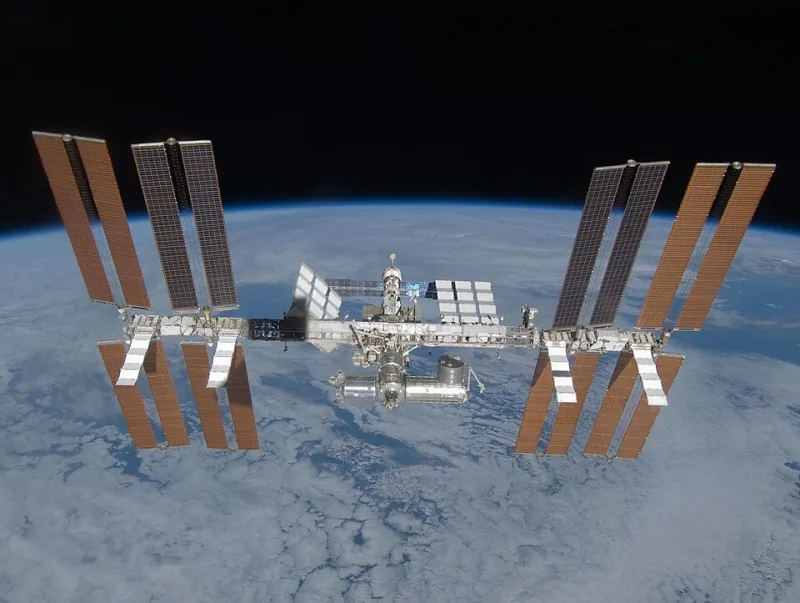
If you're someone who regularly steps outside to track the ISS, scan for meteors, or just lose yourself in a dark sky, this issue is personal. The night sky is a shared inheritance, and megaconstellations are changing it in ways that may be very difficult to reverse.
The good news is that public awareness genuinely matters here. The FCC does accept public comments on satellite licensing applications — and comments from engaged citizens carry more weight than you might expect when they arrive in volume. Organizations like the American Astronomical Society, the International Dark-Sky Association, and NOIRLab's SATCON initiative are actively working on these issues and welcome public support.
You can also make your voice heard with your congressional representatives. The Senate Commerce Committee and the House Science Committee both have jurisdiction over space policy, and constituent pressure has a track record of moving these committees to act.
For now, apps like Heavens-Above and Stellarium can help you identify satellite trails during your observing sessions — small consolation, but useful for knowing what you're looking at. And if you want to experience what's genuinely at stake, find a dark sky site away from city lights and spend an hour watching. Count the moving points of light. Then imagine ten times as many.
The universe hasn't changed. But our window onto it is getting a little more cluttered every launch day.