The Light Pollution Excuse Is Only Half Right: What Actually Determines If You'll See the ISS
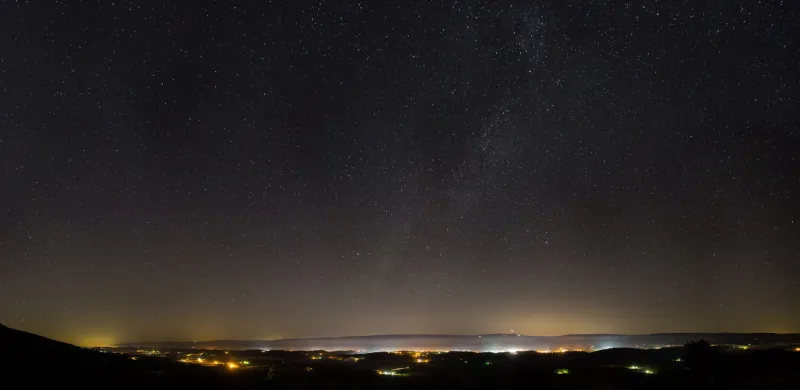
Light pollution gets blamed for a lot in amateur astronomy, and fairly so. It genuinely ruins deep-sky observation, washes out faint nebulae, and makes the Milky Way invisible from most American cities. But when it comes to watching the International Space Station, the light pollution conversation is more complicated — and more interesting — than most people realize.
The ISS, at its brightest, outshines every star in the sky and rivals Venus. It's not a faint smudge that needs dark skies to become visible. It's a moving beacon that regularly punches through suburban haze without much trouble. So why do some city observers report clear, easy sightings while others in similar locations keep missing it? The answer usually has less to do with lumens and more to do with geometry.
What Light Pollution Actually Does to an ISS Pass
Light pollution works against you by raising the background brightness of the sky. Faint objects that would stand out against a dark sky get washed out when the background glow climbs to meet them.
For the ISS, this matters most at two specific moments: the beginning and end of a pass, when the station is low on the horizon and its apparent brightness is reduced by atmospheric extinction. A pass that crests at magnitude -3 overhead might only be magnitude -0.5 or +0.5 near the horizon, where you're looking through much more air. In a heavily light-polluted sky, those horizon segments can genuinely disappear.
But the middle portion of a high pass? That's largely immune. If the ISS is going to get above 40 or 50 degrees elevation over your location, you're almost certainly going to see it from anywhere in the continental US, regardless of how many parking lots are lit up nearby.
The real question is whether the pass geometry gives you that high elevation in the first place.
The Orbital Mechanics That Actually Control Your View
Here's the factor that most observers underweight: the ISS orbits at about 51.6 degrees inclination, meaning it never passes directly overhead for anyone north of roughly 51 degrees latitude or south of 51 degrees south. For most of the continental US, you're between 25 and 49 degrees north — well within the station's coverage zone.
But inclination alone doesn't tell you much about any specific pass. What matters for a given night is the combination of your latitude, the station's current orbital plane orientation, and the geometry of where the pass falls relative to your location.
Low passes are common and often forgettable. A pass that maxes out at 15 degrees above the horizon is short, dim at peak, and heavily affected by both atmospheric haze and light pollution. These are the passes that disappoint people and make them think the ISS is hard to see.
High passes are rare and spectacular. When the geometry lines up for a pass that arcs to 70, 80, or even 85 degrees overhead, you get a long, bright arc that dominates the sky. These passes are visible from downtown Manhattan, downtown Chicago, downtown Houston — light pollution and all.
The frequency of high passes at your location varies dramatically by latitude and time of year. This is the variable most people never check.
A Tale of Three Cities
Consider three different observer scenarios to illustrate how this plays out in practice.
Phoenix, Arizona sits at about 33 degrees north in a desert environment with notoriously dark surrounding skies — but the city itself produces significant light pollution. During a period when the ISS orbital plane is favorably aligned, Phoenix observers can get multiple high-elevation passes per week, some cresting above 70 degrees. Light pollution barely matters. During unfavorable orbital geometry periods, even the darkest nearby desert sites can't compensate for passes that stay below 20 degrees.
Seattle, Washington sits at nearly 48 degrees north — close to the upper edge of the ISS coverage zone. Observers here get passes, but truly overhead passes are rarer than they are for someone in Atlanta or Dallas. Seattle's notoriously cloudy skies are a bigger practical barrier than its light pollution, but the geometry limitation is real and measurable. A clear night in Seattle with a 25-degree maximum pass is less useful than an equivalent night in Nashville with a 65-degree pass, regardless of relative sky darkness.
Miami, Florida at 25 degrees north sits near the southern edge of the favorable zone. The ISS passes frequently, but the maximum elevation for any given pass is constrained by how far south the station's ground track swings. Miami observers can see spectacular high passes during certain orbital windows, but they also get long stretches where passes are consistently low in the northern sky — and low passes, as established, are where light pollution actually starts to bite.
The Metric You Should Be Checking
Before you write off a night because you live in a bright suburb, check the maximum elevation of the predicted pass. This single number tells you more about whether you'll actually see something than any light pollution map.
As a rough guide for observers in the continental US:
- Below 20 degrees maximum elevation: Challenging even under dark skies. Not worth prioritizing unless it's all you have.
- 20 to 40 degrees: Visible from suburban locations, especially in the brightest portion of the arc. Light pollution starts to matter at the low end.
- Above 40 degrees: Reliably visible from most US cities. Light pollution is a marginal factor.
- Above 60 degrees: These are your marquee passes. Watch them regardless of where you live.
Most tracking apps display maximum elevation prominently. Heavens-Above.com and Spot the Station (NASA's official tool) both include it. Make it the first thing you check when deciding whether a given night is worth your time.
When Light Pollution Does Win
To be fair to the light pollution camp: there are real scenarios where sky brightness is the deciding factor.
If you're specifically trying to photograph the ISS against a star field, urban light pollution absolutely degrades image quality. The station itself will show up fine, but the background will be blown out. For transit photography — catching the ISS crossing the sun or moon — sky brightness is irrelevant.
For extended visual sessions where you're watching multiple consecutive passes over several hours, haze and light-amplifying moisture in urban air can make the low-horizon portions of passes genuinely invisible in ways that affect your overall experience.
And if you're introducing someone to astronomy more broadly — using an ISS pass as a gateway to pointing out constellations and planets — a darker sky genuinely enriches the experience, even if the ISS itself would have been visible either way.
The Bottom Line
Light pollution is a real factor in ISS observation, but it's rarely the primary one. Before you drive an hour to escape the city glow, check whether the pass geometry on that particular night actually justifies the effort. A 75-degree pass from your driveway will almost always beat a 20-degree pass from a state park.
Track the geometry first. Let the light pollution conversation come second. Your results will improve, and you might be surprised how often the best ISS views are waiting right outside your front door.