One Sighting Isn't Enough: Your 30-Day Plan to Actually Track the ISS
Photo: Unknown authorUnknown author, CC0, via Wikimedia Commons
You've done it. You stepped outside one evening, someone pointed at a bright dot gliding silently across the sky, and for about two minutes you were completely hooked. Then life happened. The next pass came and went while you were watching TV. The one after that? You forgot entirely. Sound familiar?
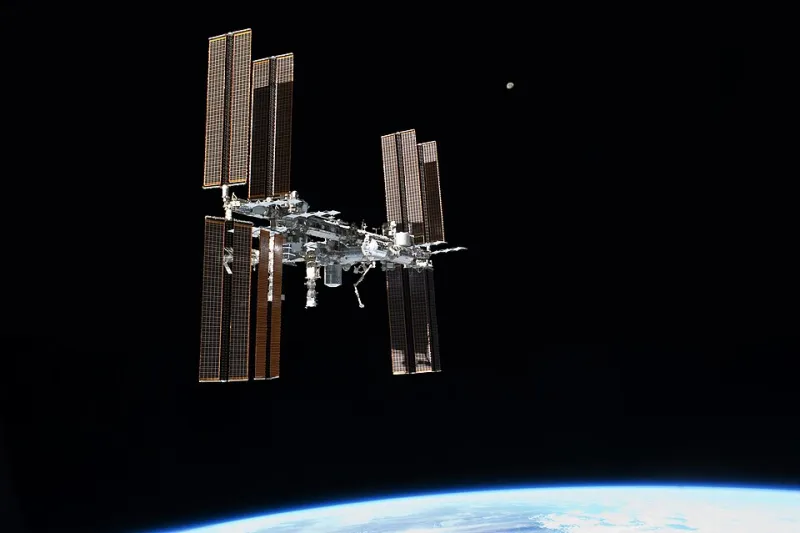
Here's the thing: the International Space Station doesn't care about your schedule. It orbits Earth roughly every 90 minutes, completing about 16 laps per day. On any given week, it's visible from your backyard multiple times — sometimes at a perfectly reasonable hour, sometimes at 5:30 a.m. when you're barely coherent. The station isn't the problem. The problem is that most of us treat a single sighting like a completed task rather than the beginning of something genuinely interesting.
This guide is about breaking that pattern. Not with guilt, but with a practical, low-pressure framework that fits real American life — commutes, kids, unpredictable weather, and all.
Why We Stop After One
Psychologists who study habit formation talk a lot about what's called the "novelty cliff" — that sharp drop-off in motivation once the initial thrill of a new experience fades. Spotting the ISS for the first time is novel. Spotting it for the fourth time on a Tuesday night when you're tired? That takes something the first sighting didn't require: intention.
There's also a practical friction problem. Unlike checking social media, observing the ISS has real prerequisites. You need to know when it's passing, you need to be outside at the right moment, and you need at least a partially clear sky. Each one of those steps is a small hurdle. Stack them together and it's surprisingly easy to just... not bother.
The solution isn't to care more. It's to reduce friction until the habit almost runs itself.
Setting Up Your Tracking Toolkit
Before you commit to 30 days, spend about 15 minutes building your foundation. You don't need a telescope, a star chart, or any specialized equipment. You need three things:
A reliable pass predictor. NASA's Spot the Station tool (spotthestation.nasa.gov) lets you enter your city and get a list of upcoming visible passes, including time, duration, and maximum brightness. Bookmark it. Better yet, sign up for email or text alerts so the station essentially taps you on the shoulder before each pass.
A simple log. A notes app on your phone works perfectly. You're just recording the date, pass time, whether you saw it, sky conditions, and a one-line observation. Nothing elaborate. The act of logging is what transforms a passive glance into active learning.
A consistent alert. Set a recurring phone alarm for 10 minutes before your most convenient daily pass window. Even if you miss that particular pass, the alarm keeps the habit alive in your brain.
The 30-Day Challenge Framework
Here's how to structure your first month without burning out or overcomplicating things.
Days 1–7: Just Show Up
Your only goal this week is to get outside for at least three passes. Don't worry about logging details. Don't worry about identifying anything else in the sky. Just confirm that the station looks the way you expect it to — steady, bright, no blinking — and give yourself credit for being there. You're building the show-up muscle, which is the hardest one.
Days 8–14: Start the Log
Now you add the notebook (or notes app). After each sighting, jot down three things: the time the ISS appeared, the direction it traveled, and how bright it seemed compared to nearby stars. That last part is more interesting than it sounds. The station's apparent brightness varies depending on its angle relative to the sun and your position on Earth — and you'll start noticing that variation faster than you'd expect.
Days 15–21: Widen Your Sky
This is where the ISS becomes a gateway rather than the destination. During your observation windows, spend five minutes before or after the pass just looking around. Use a free app like SkySafari or Stellarium to identify one or two bright objects you can see without any equipment. Maybe it's Jupiter hanging low in the southwest. Maybe it's the Pleiades cluster, which looks like a tiny smudge to the naked eye but reveals itself as a cluster of stars with even modest binoculars. The ISS got you outside. Now let the rest of the sky keep you there.
Days 22–30: Reflect and Extend
Pull up your log from the past three weeks. You'll likely be surprised by how much data you've collected without really trying. Look for patterns: which pass times work best for your schedule? Which directions tend to give you the longest sightings? Has your eye gotten faster at picking up the station's motion against the star background? This reflection phase is what separates a month-long experiment from a lasting habit. It gives your brain evidence that the effort was worth it — which makes continuing feel natural rather than forced.
Integrating Passes Into Daily Life
The observers who stick with this long-term aren't necessarily more motivated than everyone else. They've just found ways to attach the habit to things they're already doing.
If you walk a dog in the evening, check the pass predictor before you head out. If you drink coffee on a porch in the morning, look up the 5–6 a.m. window the night before. If you have kids, make a game of it — whoever spots the ISS first gets to pick what's for dessert. (This works embarrassingly well.)
The other trick is to lower your minimum viable observation. You don't need perfect dark skies, a clear horizon in every direction, or a 6-minute maximum-elevation pass. Even a 2-minute, low-angle sighting counts. Even logging "cloudy, missed it" counts. Showing up consistently — even when conditions aren't ideal — is what builds the habit.
What Consistent Observation Actually Teaches You
Here's something that doesn't get talked about enough: regular ISS tracking is genuinely good training for all kinds of sky watching. Your eyes adapt to finding moving objects against a star field. You get comfortable orienting yourself by compass direction at night. You start to internalize the rhythm of the sky — how it rotates, which objects are seasonal, why the same pass time produces wildly different viewing conditions depending on the time of year.
None of that comes from a single sighting. It comes from showing up over and over until the sky starts to feel familiar.
The ISS has been orbiting continuously since 1998. It's been overhead while you slept, while you worked, while you sat in traffic on the interstate. It'll pass over your zip code again before you finish reading this article. The only question is whether you'll be outside to see it.
Thirty days. Three things in a notes app. One alarm on your phone. That's the whole plan. The cosmos will handle the rest.