Chasing the ISS Shadow: How Umbral Geometry Turns Twilight Into a Spectator Sport
Photo: NASA/Goddard Space Flight Center, CC BY 2.0, via Wikimedia Commons
When the ISS Becomes More Than a Dot
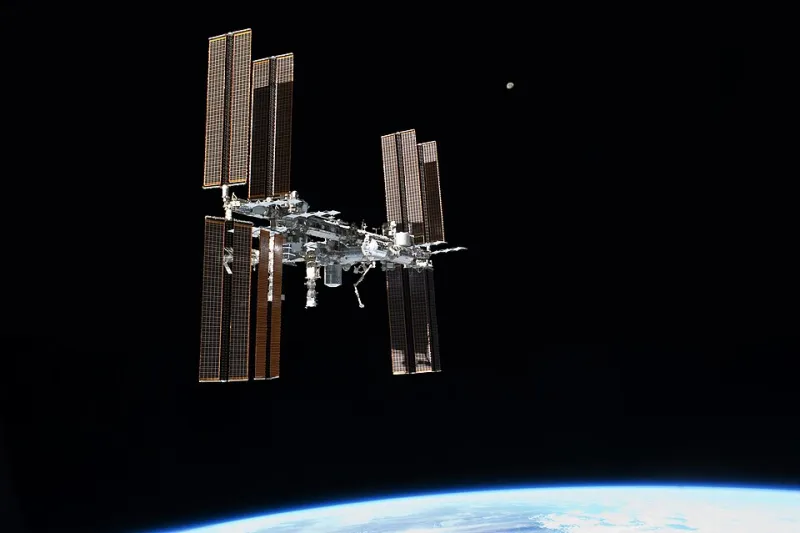
If you've spent any time tracking the International Space Station, you already know the thrill of spotting that steady, brilliant point of light cruising across the sky. But there's a lesser-known phenomenon that takes ISS observation into genuinely wild territory: the shadow pass.
During certain twilight windows, the ISS can enter or exit Earth's shadow in a way that's completely visible to the naked eye from the ground. One moment the station is glowing brightly, catching full sunlight. Then — sometimes over just a few seconds — it dims, fades, and disappears as it slides into Earth's umbra. Or, depending on your timing, you catch it doing the reverse: blinking into existence out of apparent nothingness as it emerges from shadow into sunlight.
This isn't a trick of the atmosphere or your eyes adjusting. It's pure orbital geometry playing out in real time, right above your backyard.
Understanding the Geometry: Earth's Shadow Cone
To appreciate why shadow passes happen when they do, it helps to think of Earth not as a solid ball blocking sunlight, but as an object casting a long, cone-shaped shadow into space. That cone has two distinct regions astronomers have named for centuries.
The umbra is the inner cone — the zone of total shadow where no direct sunlight reaches. The ISS, orbiting at roughly 250 miles above Earth's surface, passes through this zone during every orbit when it's on the nighttime side of the planet. That part is completely routine.
The penumbra is the outer, softer shadow where sunlight is only partially blocked. The station passes through this zone briefly during every transition between sunlit and shadowed orbit.
What makes a shadow pass observable from the ground is the relationship between your position, the station's orbital path, and the sun's angle below the horizon. During deep night, you can't see the ISS at all — it's in Earth's shadow and there's no reflected sunlight to spot. During full daylight, the sky is too bright to notice the station even when it's overhead. The sweet spot is twilight: roughly 30 to 90 minutes after sunset or before sunrise, when the sky is dark enough for the ISS to be visible but the sun is still illuminating objects at orbital altitude.
During these windows, you can actually watch the station transition between sunlit and shadowed states. That's the shadow pass.
What You'll Actually See
The visual experience depends heavily on which direction the shadow event is happening relative to your position.
If the ISS is moving from sunlit orbit into Earth's umbra during a pass over your location, you'll see a gradual or sometimes surprisingly sudden dimming. The station doesn't just go from bright to invisible in a snap — it often passes through a brief amber or reddish tint as it catches refracted light through Earth's atmosphere on the way into shadow. Think of it as a miniature version of what happens to the moon during a lunar eclipse. The same physics apply, just compressed into a few seconds.
If the station is emerging from shadow into sunlight, the effect runs in reverse: the ISS seemingly materializes out of a dark patch of sky, brightening rapidly as it picks up direct solar illumination.
Both events are striking. Both are worth planning for specifically.
Tools for Predicting Shadow Entry and Exit
Here's where the practical side of this hobby gets genuinely fun. You don't need a physics degree to predict these events — you just need the right tools and a little patience.
Heavens-Above (heavens-above.com) remains one of the most reliable free resources for ISS pass predictions. Once you set your location, the site generates pass tables that include magnitude estimates across the arc of each pass. Passes where the magnitude gets dramatically fainter mid-arc — especially toward the end of the pass — are strong candidates for shadow entry events. When a pass is listed with an end point that shows a significant magnitude drop before the station reaches the horizon, that's your signal to look for a fade-out.
Stellarium (available as both a free web app and downloadable software) lets you simulate the sky for any date and time. Pair it with a known ISS pass time, and you can visually confirm where in the sky the shadow transition will occur relative to nearby stars or constellations. That gives you a visual anchor point to watch.
NASA's Spot the Station tool is excellent for general pass alerts but doesn't break down the shadow geometry in as much detail. Use it for initial awareness, then cross-reference with Heavens-Above for the specifics.
For the more technically inclined, CalSky (when available) and JSatTrak provide detailed orbital propagation data that can show you precisely where the ISS enters and exits Earth's shadow cone on a given pass. These tools require a bit more setup but reward you with significantly more precision.
Finding Your Ideal Viewing Location
Unlike solar transits or lunar occultations, ISS shadow passes don't require you to be at a hyper-specific geographic coordinate. The shadow transition happens at altitude — it's about the station's position relative to Earth's shadow, not your exact spot on the ground. That said, a few location factors still matter.
First, clear horizon access in the direction of the pass is essential. If the shadow event is predicted to occur when the ISS is low in the northwest, a treeline or building in that direction will ruin the show. Check your site before committing to it.
Second, light pollution matters less here than you might think. Because you're watching a relatively bright moving object rather than faint deep-sky targets, suburban locations work fine for shadow pass observation. That said, darker skies do make the contrast of the fade more dramatic and satisfying.
Third, seasonal timing shapes your opportunities. In summer across the continental US, twilight persists longer and the ISS often completes multiple observable passes per night. That increases your odds of catching a shadow event. Winter nights produce shorter twilight windows, which can actually concentrate the geometry in useful ways — but you'll have fewer total opportunities per week.
Logging and Learning From Each Pass
One of the most rewarding aspects of shadow pass observation is building your own record over time. Even a simple notebook log — date, time, location, pass direction, estimated magnitude at fade, weather conditions — gives you data to compare and refine your predictions. Over a season or two, you'll develop an intuitive sense for which pass geometries are most likely to produce visible shadow events from your specific location.
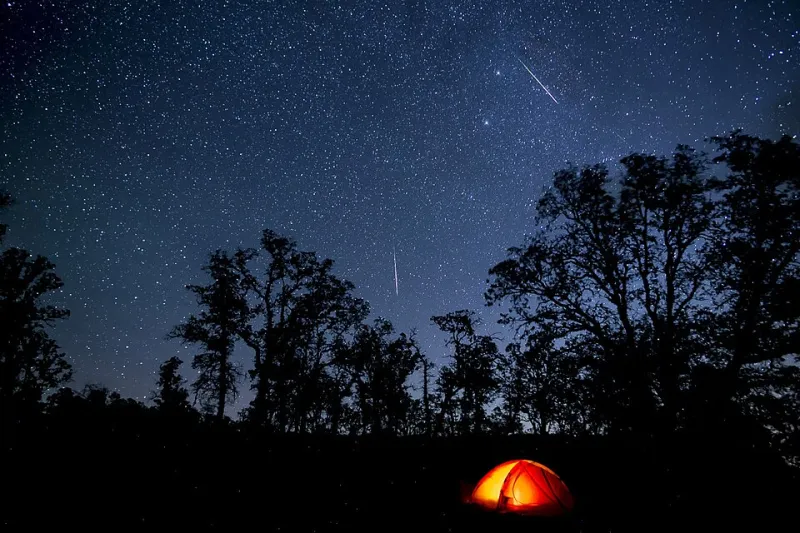
If you want to go further, a basic DSLR or mirrorless camera on a tripod can capture the ISS fade as a shortening streak in a long-exposure frame. The point where the streak ends abruptly marks the shadow entry. It's a genuinely beautiful artifact, and it's the kind of image that holds up well even compared to more technically demanding astrophotography.
The Bigger Picture
There's something quietly profound about watching the ISS disappear into Earth's shadow. You're not just seeing a satellite pass overhead — you're watching a human-built structure interact with the fundamental geometry of our solar system in real time. The same shadow cone that produces lunar eclipses, that ancient astronomers used to estimate the size of the Earth, is right there doing its thing 250 miles up while you stand in your driveway with a cup of coffee.
That's what makes this particular observation technique worth adding to your regular routine. It turns an already compelling sky event into something with genuine depth — a reminder that even familiar phenomena have layers worth digging into.
Next clear twilight, don't just watch for the ISS to appear. Watch for it to vanish.