Summer Marathons vs. Winter Blinks: The Orbital Geometry Behind ISS Visibility Windows
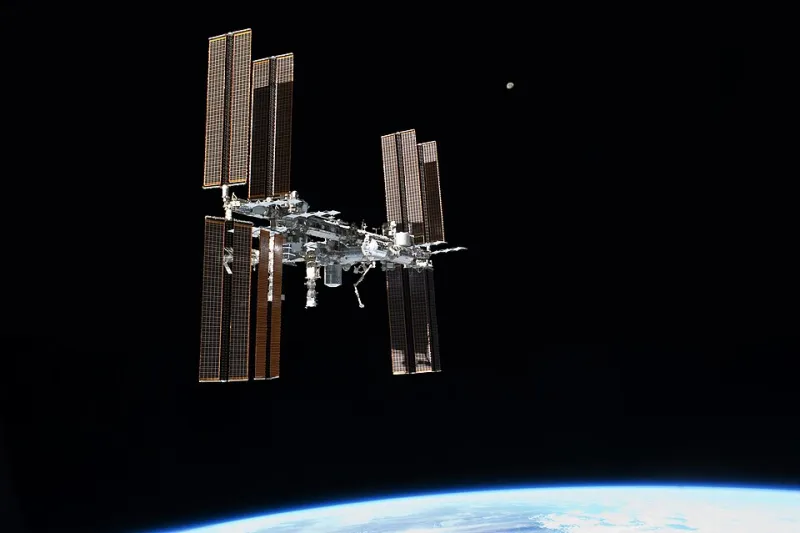
Photo: NASA, Public domain, via Wikimedia Commons
You've had both experiences. One night you watch the ISS glide serenely from horizon to horizon, giving you a full five or six minutes to grab your binoculars, point it out to your kids, and still have time to wave. Another night — maybe in January, maybe February — your tracking app promises a pass and you stare at the sky, catch a two-second glimmer low in the northwest, and that's it. Done. The station has already sunk back into Earth's shadow before you even thought to raise your arm.
Same station. Same orbit. Completely different experience. So what's actually going on?
The short answer: sunlight, shadow, and geometry. The longer answer is genuinely fascinating — and once you understand it, you'll never look at a tracking forecast the same way again.
The ISS Needs the Sun, Even When You Don't
Let's start with the most fundamental thing people forget about spotting the space station. You're not seeing the ISS because it emits light. You're seeing it because sunlight is bouncing off its enormous solar arrays — those wide, golden wings that stretch roughly the length of a football field. The station itself produces no visible glow.
That means for you to see it, two things have to be true at the same time: you need to be standing in darkness (or near-darkness), and the ISS needs to be in sunlight. That overlap — you in shadow, the station in sun — is the narrow sweet spot that makes a visible pass possible.
In the middle of the afternoon, the ISS is lit up just fine, but so is your entire sky. The station gets completely lost in the blue. At midnight in winter, you're definitely in darkness, but the ISS has likely dipped into Earth's shadow too. The geometry has to line up just right, and that alignment changes dramatically with the seasons.
Earth's Tilt Is the Real Mastermind
Here's where it gets interesting. Earth sits on a 23.5-degree axial tilt as it circles the sun. That tilt is responsible for seasons, obviously, but it also controls how deep Earth's shadow cone extends relative to your location at any given time of year.
During summer in the Northern Hemisphere — which covers most of the continental US — the North Pole is angled toward the sun. That means Earth's shadow is pushed downward, away from northern latitudes. The result: even after the sun sets on a July evening in, say, Chicago or Denver, the shadow's edge sits relatively low. An object orbiting at about 250 miles up — like the ISS — can remain in full sunlight well past your local sunset, sometimes for an hour or more.
In practical terms, that's a massive window. The station can make multiple visible passes in a single summer evening. Each pass can last four to six minutes, sometimes longer, depending on the specific geometry of that orbit. You have time. You have margin. You can set up a lawn chair.
Flip to winter. The North Pole tilts away from the sun. Earth's shadow cone now angles upward and covers more of the sky above northern latitudes. An orbiting station at 250 miles altitude gets swallowed by that shadow much faster after your local sunset — and it emerges from shadow only briefly before sunrise. The window between "you're in darkness" and "the ISS is also in darkness" shrinks dramatically. Some passes in December or January are genuinely only 60 to 90 seconds long, barely enough to register before the station fades out.
Latitude Matters More Than You Might Expect
Where you live in the US adds another layer to this. The ISS orbits at an inclination of about 51.6 degrees — meaning it swings between roughly 51.6 degrees north and south latitude as it circles Earth. For observers in the lower 48 states, the station will always pass somewhere overhead, but the angle changes depending on how far north or south you are.
If you're in Miami or Houston, the ISS tends to pass higher in the southern sky and at steeper angles. Those passes can feel shorter because the station zips through your viewing arc more quickly. But you also tend to get more nighttime passes in winter because your latitude keeps you a bit further from the worst of the shadow geometry problem.
Up in Minneapolis or Seattle, summer passes are spectacular — sometimes nearly overhead, with the station blazing across the full dome of the sky. But winter becomes genuinely stingy. You might go days without a single visible pass because the shadow geometry simply doesn't cooperate.
The "Twilight Zone" of Optimal Viewing
The best passes — the long ones, the bright ones, the ones where the ISS seems to drift forever — tend to happen within about 90 minutes of local sunset or sunrise. That's the twilight zone, and it's not a coincidence. It's exactly the period when you're in Earth's shadow but the ISS is still catching full sunlight.
In summer, that twilight window is wide and forgiving. The sky stays light longer, and the station stays sunlit longer. In winter, that window compresses. Sometimes it disappears entirely for days at a stretch.
This is also why early morning passes can be surprisingly good, especially in late winter and early spring. Just before local sunrise, the geometry reverses — you're still in darkness, but the ISS is already catching the first rays of a sun that hasn't cleared your horizon yet. Those pre-dawn passes can be long and bright, even in months when evening viewing is frustrating.
Using This Knowledge to Plan Better Watches
Once you internalize this geometry, tracking apps and prediction tables start making a lot more sense. When you pull up a pass forecast and see a maximum elevation of 80 degrees with a duration of six minutes, that's a summer gift. Block that time off. When you see maximum elevation of 12 degrees with a duration of 90 seconds, that's the winter geometry at work — still worth a look, but don't build your evening around it.
A few practical tips for squeezing the most out of whatever season you're in:
- In summer, check for passes in the hour after sunset and the hour before sunrise. Multiple passes per night are common.
- In winter, focus on the brief windows right around civil twilight — that 20 to 30 minute period just after sunset when the sky darkens fastest.
- In spring and fall, you'll often find a mix. Some evenings offer long, brilliant passes; others are short. Check elevation angles in your forecast — anything above 40 degrees is worth prioritizing.
- Regardless of season, a pass that reaches near-zenith (directly overhead) will always feel longer and more dramatic than a low-horizon pass, even if the actual duration is similar.
The Station Doesn't Change — Your Sky Does
There's something almost philosophical about this. The ISS hums along in its orbit completely indifferent to your seasons, your weather, or your schedule. It doesn't know it's July in Ohio or January in Montana. It just keeps circling, about every 90 minutes, catching sunlight and casting it back toward Earth.
What changes is the geometry between you, the station, and the sun. And that geometry — driven by Earth's tilt, your latitude, and the time of year — determines whether tonight's pass is a six-minute spectacle or a blink-and-miss-it streak.
Knowing why that happens doesn't just satisfy curiosity. It makes you a sharper observer, someone who can look at a forecast and immediately understand what kind of experience is on offer. That's the whole point of tracking the cosmos — not just watching, but understanding what you're watching.