Starlight Interrupted: Catching the ISS as It Blots Out the Sky's Brightest Lights
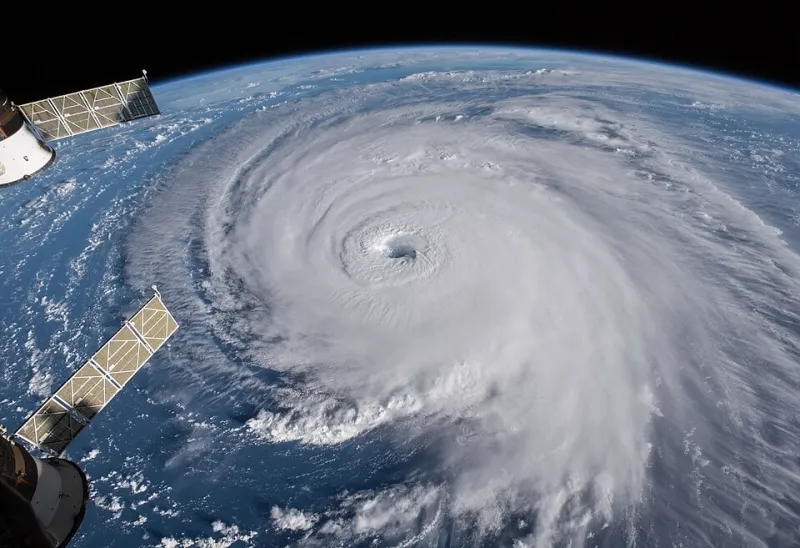
Photo: NASA/Goddard Space Flight Center, CC BY 2.0, via Wikimedia Commons
Most nights, spotting the International Space Station is pretty straightforward. You check the pass time, step outside, look in the right direction, and watch a bright dot glide silently overhead. It's satisfying every single time. But there's a whole other tier of ISS observation that most casual skywatchers don't even know exists — and once you experience it, a standard flyby starts to feel a little ordinary.
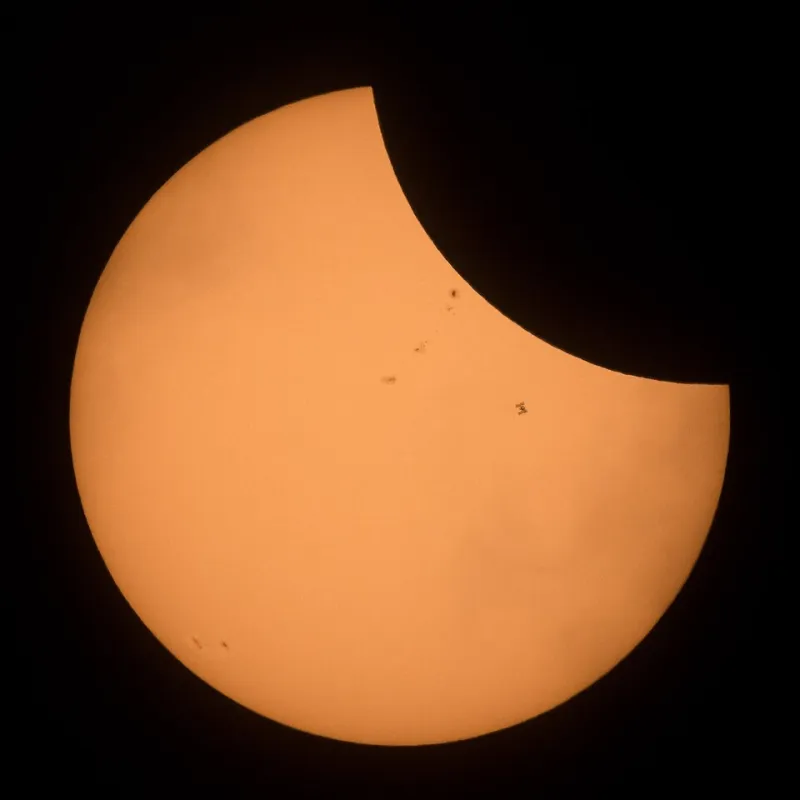
We're talking about stellar occultations and planetary transits: the rare, blink-and-miss-it moments when the ISS passes directly between you and a bright star or planet. The station doesn't just fly nearby. It actually blocks the light, creating a momentary interruption in the sky that lasts — depending on the geometry — somewhere between a fraction of a second and just over a second. That's it. One second of the universe holding its breath.
What's Actually Happening Up There
To understand why this works, it helps to think about the ISS's position in the sky not as a moving dot, but as a physical object with a real angular size. From the ground, the station spans roughly the same apparent width as a coin held at arm's length — tiny, but not nothing. When its orbital path carries it across a star's position as seen from your specific location on Earth, the star disappears for a moment. Then it snaps back on.
This is called an occultation when a solid body passes in front of a star, and a transit when an object crosses the face of something larger (like Jupiter or the Moon). The ISS can technically do both, depending on what it's passing in front of. The geometry that makes this happen is surprisingly demanding. The station has to be at the right point in its orbit, the target object has to be at the right position in the sky, and you — the observer — have to be standing in exactly the right spot on the ground. Move a few miles in any direction, and the ISS passes just above or below your target. The alignment corridor, sometimes called the shadow path, can be remarkably narrow.
Why These Are Harder to Predict Than Standard Passes
Regular ISS visibility predictions are relatively forgiving. If the station is going to be visible from your city tonight, you've got a window of several minutes and a broad swath of sky to work with. Occultation predictions are a completely different animal.
For a standard flyby, the prediction only needs to get the orbital path roughly right. For a stellar occultation, the math has to account for the exact angular position of the target star or planet, the precise orbital elements of the ISS (which are updated multiple times per day as the station adjusts altitude and orientation), and your exact GPS coordinates — not just your city, but your street. The shadow path across the ground might only be a mile or two wide. If you're outside that corridor, you'll see the ISS pass close to the star but not cover it.
This is also why occultation predictions have a shorter reliable forecast window. The ISS undergoes small orbital adjustments — called reboosts — that shift its ground track in ways that can invalidate predictions made more than a day or two in advance. You'll often be working with predictions that are only 24 to 48 hours old at most.
Tools That US Observers Can Actually Use
A few dedicated resources make it possible to chase these events without a degree in orbital mechanics. Heavens-Above remains one of the most reliable platforms for ISS pass data, and for occultation-specific predictions, the CalSky archive (now partially mirrored by community-run astronomy tools) was long the gold standard. Today, sites like Calsky's successor tools and the work shared through the International Occultation Timing Association (IOTA) give US-based observers actionable prediction data.
For planetary transits specifically — the ISS crossing the disk of Jupiter, Saturn, Mars, or Venus — apps like Stellarium combined with ISS orbital data can help you visualize upcoming geometry. Some dedicated observers run their own prediction scripts using public Two-Line Element (TLE) data from Space-Track.org. It sounds complicated, but the community around this type of observation is genuinely helpful, and plenty of tutorials exist for skywatchers who want to go deeper.
The key inputs you'll need: your precise latitude and longitude (a GPS app on your phone works fine), the current TLE data for the ISS, and the right ascension and declination of your target object. From there, prediction software does the heavy lifting.
Setting Up for the Moment Itself
Here's where things get genuinely exciting — and a little nerve-wracking. Unlike a solar transit, where you have a minute or more to observe, a stellar occultation by the ISS is over in under a second. You don't really watch it happen. You record it, then review the footage.
The standard setup among serious occultation observers involves a video camera — even a basic one — pointed at the target star through a telescope or binoculars. Recording at 30 frames per second (or higher, if your equipment allows) gives you the ability to pinpoint the exact moment of disappearance and reappearance to within a fraction of a second. Some observers use dedicated astronomy cameras that can shoot at 60fps or faster. The ISS itself may briefly appear as a recognizable shape in the frame if you're using enough magnification, though at its typical angular size, it's more of a blur than a silhouette.
If you're not set up for video, you can still observe visually — but you'll need your eye locked on the target star well before the predicted time. The temptation to look for the approaching ISS is understandable, but counterproductive. Trust the prediction. Keep your gaze on the star. When it winks out, you'll know.
The Targets Worth Chasing
Not all stars make equally satisfying targets. The brightest and most rewarding occultation events involve first-magnitude stars — think Vega, Arcturus, Antares, Spica, or Regulus — because the contrast between the star's light and the surrounding sky is dramatic enough that the disappearance is unmistakable. Planets are even better targets in some ways, because they're bright enough to observe without optical aids, though their larger angular diameter means the ISS may not fully cover them.
Jupiter transits are a particular favorite in the observer community. The planet is bright enough to watch with the naked eye, and seeing a tiny mechanical object cross its disk — even briefly — creates a visceral sense of scale. You're watching a football-field-sized space station cross a planet 400 million miles away.
A Different Kind of Connection to the Station
There's something philosophically interesting about this type of observation. Standard ISS passes remind you that humans are up there, orbiting overhead. Occultation events remind you that the station is a physical object occupying real space in a three-dimensional universe — one that can, under the right conditions, actually interrupt your line of sight to objects billions of miles away.
It's the kind of observation that makes the cosmos feel genuinely interconnected. The station, the star, and you — briefly, perfectly aligned. Then the moment passes, and the sky looks exactly like it did before.
That's the thing about rare events. They're worth the effort precisely because they don't happen on a schedule you can take for granted.