What Those Space Station Tracking Numbers Actually Mean (And Why They Matter)

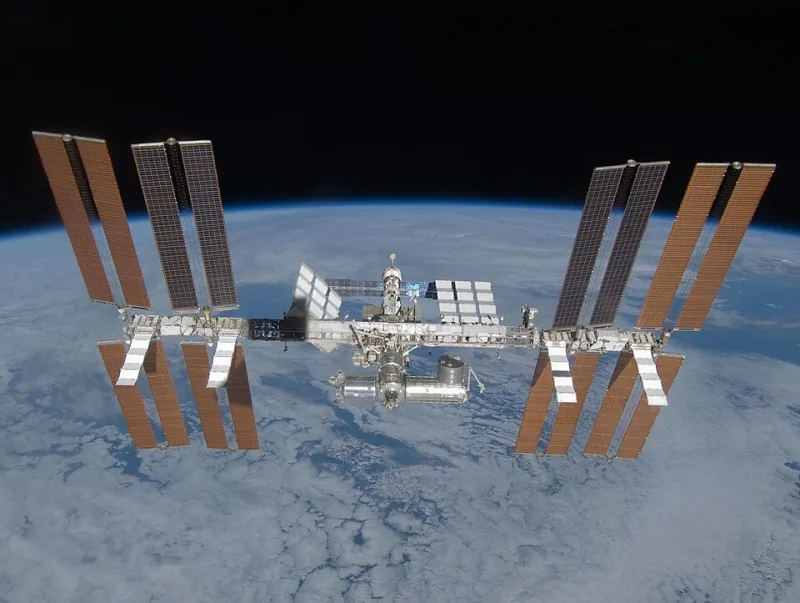
Photo: Unknown authorUnknown author, Public domain, via Wikimedia Commons
You've probably done it before. You pull up a space station tracking site, find a pass time for your city, walk outside at the right moment, and scan the sky hoping something bright slides overhead. Maybe you spot it. Maybe you don't. Either way, you probably ignored the columns of numbers sitting right next to that timestamp.
That's a shame — because those numbers are basically a treasure map.
Once you understand what elevation angles, azimuth bearings, and magnitude values are actually telling you, you stop guessing and start knowing. You'll know exactly where to look the second you step outside. You'll know which passes are worth setting an alarm for and which ones barely clear the rooftops. Here's how to crack the code.
The Elevation Angle: Your Most Important Number
Elevation is the first thing you should check on any pass prediction table. It measures how high above your horizon the ISS will appear, expressed in degrees. Zero degrees is the horizon itself — think of the line where the sky meets the ground. Ninety degrees is directly overhead, a point astronomers call the zenith.
A pass with a maximum elevation of 10° means the station barely scrapes above the horizon. You'll need a completely unobstructed view in that direction, and atmospheric haze near the ground will dim the station considerably. These low passes are tough, especially if you're in a city, surrounded by trees, or anywhere near hills.
A maximum elevation of 45° or higher is where things get exciting. At those angles, the ISS climbs well into your sky, spends more time visible, and shines at its brightest. Passes that top out above 60° are the ones to circle on your calendar.
Most pass prediction tables show you three key moments: when the station first appears (AOS, or Acquisition of Signal), when it reaches maximum elevation, and when it disappears (LOS, Loss of Signal). The elevation column shows a value for each of those moments. Don't just glance at the max — watch how the number rises and falls. A pass that starts at 10°, climbs to 80°, and drops back to 10° is going to feel dramatically different from one that stays between 15° and 25° the whole time.
Azimuth Bearings: Stop Spinning in Circles
Here's the scenario: the ISS is supposed to appear in two minutes and you have no idea which direction to face. You spin around, squint at the sky, and by the time you orient yourself, the station has already passed its peak.
Azimuth solves this. It's simply a compass direction expressed in degrees, running clockwise from north. North is 0° (or 360°), east is 90°, south is 180°, and west is 270°. Your phone's compass app is all you need to translate these numbers into a real direction.
Pass prediction tables typically list the azimuth for AOS, max elevation, and LOS. So a table might tell you the ISS appears at azimuth 230° (southwest), reaches its peak near azimuth 165° (south-southeast), and disappears at azimuth 95° (east). That tells you to start facing southwest, then slowly pivot right as the station arcs across the southern sky.
Knowing the azimuth ahead of time also helps you scope out obstructions. If the ISS is rising in the northeast and you've got a line of oak trees on your northeast fence line, that's useful information before you haul a lawn chair outside.
Magnitude: Learning to Predict Brightness
Magnitude is the astronomer's scale for brightness. It runs backward from what you might expect — lower numbers, and especially negative numbers, mean brighter objects. The full moon sits around -12.7. Venus can hit -4.9. A typical naked-eye star hovers somewhere between 1 and 3.
The ISS, when conditions are right, can blaze at -5 or -6 magnitude — outshining everything in the night sky except the moon. But on a poor pass, it might only reach 1 or 2, looking like just another moving star.
Pass prediction tables list the expected magnitude at maximum brightness. Anything at -2 or brighter is worth your full attention. Those are the passes where neighbors come out of their houses asking what that moving light is. Passes dimmer than +2 are still worth seeing, but don't expect a showstopper.
One important caveat: predicted magnitude assumes the ISS is in full sunlight. If the station enters Earth's shadow mid-pass — something the prediction table will sometimes flag — you'll watch it literally fade and disappear before it reaches your horizon. That's actually one of the coolest things you can witness, so don't treat it as a disappointment.
Putting It All Together: Reading a Full Pass Prediction
Let's walk through a realistic example. Say you're in Dallas, Texas, and the table shows:
- AOS: 9:14 PM, Elevation 10°, Azimuth 247° (WSW)
- Max Elevation: 9:17 PM, Elevation 72°, Azimuth 175° (S)
- LOS: 9:20 PM, Elevation 11°, Azimuth 103° (ESE)
- Magnitude at Max: -3.5
Here's your game plan. At 9:13 PM, head outside and face west-southwest. Keep your eyes about 10° above the horizon — roughly the height of your fist held at arm's length. At 9:14, a bright moving point of light appears there. Over the next three minutes, it climbs steeply toward the south, reaching nearly overhead by 9:17 before arcing down toward the east-southeast. The whole pass lasts six minutes. At magnitude -3.5, it's going to be unmistakably bright — brighter than any star in the sky.
That's a completely different experience from reading "ISS visible at 9:14 PM." You're not hoping for the best. You're watching it happen on your terms.
One More Thing: Your Horizon Matters More Than You Think
All of these predictions assume a flat, unobstructed horizon. In real life, your backyard might have a fence, a garage, or a neighbor's second story cutting into your sightlines. Subtract a few degrees from your effective horizon in any direction where you have obstructions, and mentally adjust your AOS and LOS times accordingly.
Apps like Heavens-Above and Spot the Station let you filter passes by minimum elevation — set that threshold to at least 30° and you'll automatically weed out the frustrating low-angle passes before they even hit your list.
The ISS completes an orbit roughly every 90 minutes and passes over most US locations multiple times a day. With the right data in hand, you're not just watching a light cross the sky — you're tracking a crewed spacecraft the size of a football field, and you know exactly where it's going to be before it gets there. That's a different kind of sky watching entirely.