Too Close for Comfort: The Real Story of Near-Misses in Earth Orbit
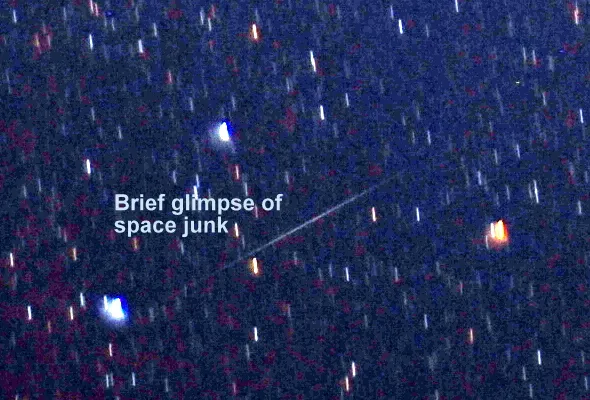
Photo: BobMacInnes, CC BY 2.0, via Wikimedia Commons
In June 2021, the crew of the International Space Station was told to shelter in place. Not because of a fire, not because of a medical emergency — because a piece of space debris was headed their way and nobody was entirely sure where it was going. The astronauts sealed themselves into their docked Soyuz and Dragon capsules and waited. The debris passed without incident. Nobody was hurt. And within a few hours, life on the station returned to something resembling normal.
That incident barely made the news. It probably should have made more.
The Invisible Traffic Problem
From the ground, Earth orbit looks empty. Even with a telescope, you're mostly seeing stars. But in the zone between roughly 200 and 2,000 kilometers altitude — the region called low Earth orbit — there are currently more than 27,000 tracked objects larger than a softball, and an estimated half-million pieces too small to catalog but large enough to be catastrophic on impact.
The ISS sits at about 420 kilometers up, right in the middle of this mess. It's moving at approximately 7.7 kilometers per second. At that speed, a collision with even a centimeter-sized fragment releases energy comparable to a hand grenade. A direct hit from something larger would be unsurvivable.
This isn't hypothetical risk management. It's the lived reality of operating a crewed outpost in an increasingly congested environment — and the agencies responsible for keeping that station intact have been quietly managing it for decades.
Documented Close Calls: The Events That Actually Happened
NASA and its international partners track what they call "conjunction events" — instances where a tracked object is predicted to pass within a defined safety threshold of the ISS. The station performs what's known as a Debris Avoidance Maneuver, or DAM, when the risk crosses an acceptable threshold. These aren't rare edge cases.
Since the ISS became continuously crewed in 2000, the station has executed more than 30 documented avoidance maneuvers. Several stand out.
In 2009, debris from the collision between the defunct Russian Cosmos 2251 satellite and the operational Iridium 33 commercial satellite created a massive debris cloud. That single event — the first accidental hypervelocity collision between two intact satellites — added thousands of new trackable fragments to the environment the ISS navigates every day. It's still contributing to conjunction events years later.
In 2012, the station maneuvered to avoid a fragment from a Chinese weather satellite, Fengyun-1C, that had been deliberately destroyed in an anti-satellite weapons test in 2007. That test alone created more than 3,000 trackable debris fragments and remains one of the single largest contributions to the debris problem in history.
More recently, in November 2021, Russia conducted its own anti-satellite test, destroying the defunct Cosmos 1408 satellite and generating a debris cloud that forced ISS crew members to shelter in their return vehicles multiple times over the following days. The international response was swift and sharp — NASA Administrator Bill Nelson called it "reckless and dangerous" — but the debris is still up there.
How the Warning System Works
The US Space Surveillance Network, operated by US Space Command, tracks objects in orbit using a global network of ground-based radars and optical sensors. When a tracked object is predicted to come within roughly 1.4 kilometers laterally and 0.5 kilometers radially of the ISS, it triggers an alert.
Mission controllers at NASA's Johnson Space Center in Houston then run probability calculations. If the estimated probability of collision exceeds 1 in 10,000, a maneuver is seriously considered. If it exceeds 1 in 1,000, a maneuver is typically executed unless other constraints make it impossible.
The timing matters enormously. An ideal avoidance maneuver happens well in advance — 24 to 48 hours before closest approach — using one of the station's thrusters or a docked spacecraft's engines to slightly adjust the ISS orbit. A small velocity change of just a meter or two per second, applied at the right moment, shifts the station's position by kilometers at the time of the conjunction.
The nightmare scenario is a late warning. If a debris object is only identified as a serious threat within a few hours of closest approach, the station may not have enough time to safely plan and execute a burn. In those situations, the crew shelters in docked vehicles and waits.
The Objects Nobody Can Track
Here's the part that keeps orbital safety engineers up at night: the surveillance network can reliably track objects larger than roughly 10 centimeters in low Earth orbit. Below that size, the catalog gets spotty. Objects in the 1–10 centimeter range — small enough to be invisible to current sensors, large enough to punch through the ISS hull — number in the hundreds of thousands.
The station does have some protection. Its most exposed surfaces are shielded with Whipple shields, layered structures designed to vaporize small impactors before they penetrate the pressure vessel. But these shields have limits, and they can't cover everything.
Evidence of impacts is visible on the station itself. Windows have been replaced after micrometeorite strikes. In 2016, a photo of the station's Cupola module showed a chip in one of its windows from a particle believed to be just a few thousandths of a millimeter across — a paint fleck or tiny metal fragment moving at orbital velocity. The damage was minor. The reminder was significant.
What Comes Next
The debris problem is compounding. Every year, more satellites are launched. Every collision, every anti-satellite test, every rocket body left in orbit adds to the total count. The concept of Kessler Syndrome — a cascade where collisions generate debris that causes more collisions — is no longer purely theoretical. Researchers debate how close to that threshold certain orbital shells already are.
Efforts to address the problem are real but slow. Active debris removal missions are in early development stages. Several companies and space agencies are working on technologies to capture and deorbit defunct satellites. International agreements on debris mitigation exist but lack enforcement mechanisms.
For the ISS specifically, the station's operational life is currently planned through 2030, after which NASA intends to deorbit it in a controlled reentry. That deorbit itself will be one of the most complex maneuvers in the station's history — a deliberate, precisely calculated end to 30-plus years of continuous human presence in orbit.
Until then, the conjunction alerts keep coming. The mission controllers keep calculating. And the crew keeps doing what astronauts have always done: trusting the math, trusting the people on the ground, and looking out the window at a planet that has no idea how much work goes into keeping them up there.
Tracking the ISS from your backyard is a genuinely rewarding hobby. But knowing what it takes to keep that light moving safely across the sky? That adds a whole other dimension to the experience.