The Other Space Stations: A Watcher's Guide to the Orbital Outposts Beyond the ISS
Photo: John Robert McPherson, CC BY-SA 4.0, via Wikimedia Commons
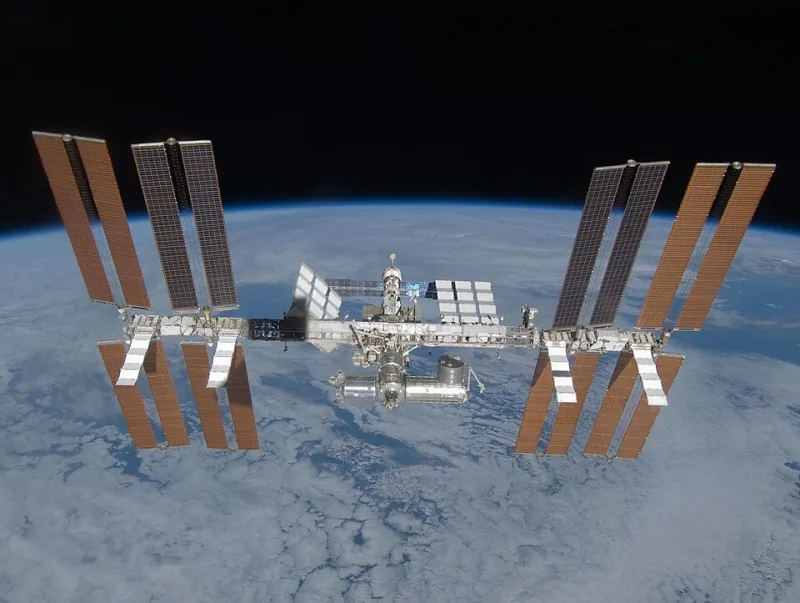
For most Americans, "space station" means one thing: the ISS. It's been continuously inhabited since 2000, it's the size of a football field, and on a clear night it's bright enough to stop you in your tracks. But the ISS is aging, its retirement is on the horizon, and the orbital real estate market is suddenly a lot more competitive than it used to be.
The story of what's coming next — and what's already up there — is one of the most consequential chapters in the history of space exploration. It's also a story with very real implications for anyone who loves tracking the cosmos from their backyard.
Tiangong: China's Station Is Already There
Let's start with the most significant development most Americans are still underestimating. China's Tiangong Space Station isn't a future project. It's operational right now.
Tiangong — the name translates to "Heavenly Palace" — achieved its core configuration in late 2022, assembling a three-module structure in low Earth orbit. It's smaller than the ISS but built on a newer design philosophy, with a permanent crew of three taikonauts rotating through on six-month missions. The station hosts a growing suite of science experiments, and China has plans to expand its capabilities over the coming years.
For amateur observers, Tiangong is genuinely trackable. It orbits at a lower inclination than the ISS — around 41 to 43 degrees — which means it's most visible to observers in the southern and mid-latitude United States, and less frequently seen from northern states. It's dimmer than the ISS (roughly magnitude 2 to 3 on a good pass versus the ISS's potential -4 or brighter), but a clear, high-elevation pass is absolutely within reach of the naked eye.
Tracking tools that pull from public orbital data — including Two-Line Element sets updated regularly by space surveillance networks — can give you pass predictions for Tiangong just like they do for the ISS. The station is listed under its NORAD catalog designation, so look for "CSS" (Chinese Space Station) in satellite databases.
The Geopolitics You Can See From Your Yard
There's a reason Tiangong exists as a standalone station rather than a module on the ISS: US law. Specifically, a 2011 provision known as the Wolf Amendment prohibits NASA from using federal funds for direct bilateral cooperation with China's space program without explicit congressional approval and FBI certification. The practical effect has been that Chinese taikonauts have never visited the ISS, and Chinese space ambitions have developed along an entirely independent track.
The result is that we now have two competing visions of human spaceflight operating simultaneously in low Earth orbit. That's not inherently a bad thing — competition has historically pushed both sides to move faster and invest more — but it does fragment the scientific community and raises questions about long-term coordination on safety, debris management, and future exploration goals.
For observers, it's a remarkable moment. On a single night, with the right pass timing, it's theoretically possible to watch both the ISS and Tiangong cross your sky. Two crewed outposts, two different flags, two different futures for human presence in space — visible from a lawn chair.
Commercial Stations: The Next Wave Is Coming
The ISS's planned deorbit around 2030 has lit a fire under a new generation of commercial space station developers. NASA's Commercial Low Earth Orbit Destinations (CLD) program is actively funding multiple private station concepts, with the goal of having at least one operational before the ISS comes down.
The frontrunners include:
Axiom Station — Axiom Space, a Houston-based company, is already attaching commercial modules to the ISS as a transitional step. Their long-term plan is to detach those modules and form an independent station once the ISS is retired. They've already hosted private astronaut missions to the ISS and have NASA funding to develop their free-flying station.
Starlab — A joint venture involving Voyager Space and Airbus, Starlab is designed as a single large-volume station capable of hosting four astronauts. It's targeting a mid-2030s launch and has significant research partnerships already in place.
Blue Origin's Orbital Reef — Jeff Bezos's aerospace company is developing a "mixed-use business park in space" concept, designed to support both commercial and government research. Blue Origin is betting that demand for orbital access will expand dramatically once the price drops — a reasonable bet, given the trajectory of launch costs.
None of these are in orbit yet, but they're real programs with real funding and real timelines. Within a decade, the night sky could have several bright, trackable outposts overhead rather than just one.
What This Means for Skywatchers
The proliferation of space stations creates both opportunity and complexity for amateur astronomers and satellite watchers.
On the opportunity side: more stations mean more chances to see crewed spacecraft overhead. If Tiangong isn't well-positioned for your latitude on a given week, Axiom Station might be. Variety is genuinely exciting.
On the complexity side: tracking multiple stations requires a bit more homework. Each orbits at a different altitude and inclination, meaning the visibility patterns, brightness levels, and pass frequencies all differ. What works for ISS tracking — knowing your seasonal windows, targeting high-elevation passes — applies broadly, but you'll need to check station-specific predictions rather than assuming they all behave the same way.
There's also the broader context of an increasingly crowded low Earth orbit. Megaconstellations of communication satellites are already complicating the view for astronomers. More stations, more commercial traffic, and more debris all add up to a more complex orbital environment — one worth paying attention to, both as an observer and as a citizen thinking about the long-term future of the space around our planet.
How to Start Tracking Beyond the ISS
If you want to expand your satellite-watching practice beyond the ISS, here's a simple starting point:
- Find Tiangong pass predictions using a satellite tracker that supports custom NORAD IDs. Search for "CSS" or "Tiangong" in the satellite database — most major trackers include it.
- Check your latitude. Tiangong's lower inclination makes it less visible from northern states. If you're in the South or Southwest, you'll have better luck.
- Set realistic brightness expectations. Tiangong won't dazzle you the way the ISS can. Aim for high passes (above 40 degrees) and a dark sky.
- Bookmark commercial station news. As Axiom modules and other platforms launch, tracking communities will quickly add them to satellite databases. Staying current means you'll be ready to look up the moment something new goes into orbit.
The ISS is extraordinary. But the next chapter of human spaceflight is already being written overhead, and you don't need anything more than your eyes and a little curiosity to follow along.