Six Seconds of Glory: How to Calculate When the ISS Crosses the Sun or Moon
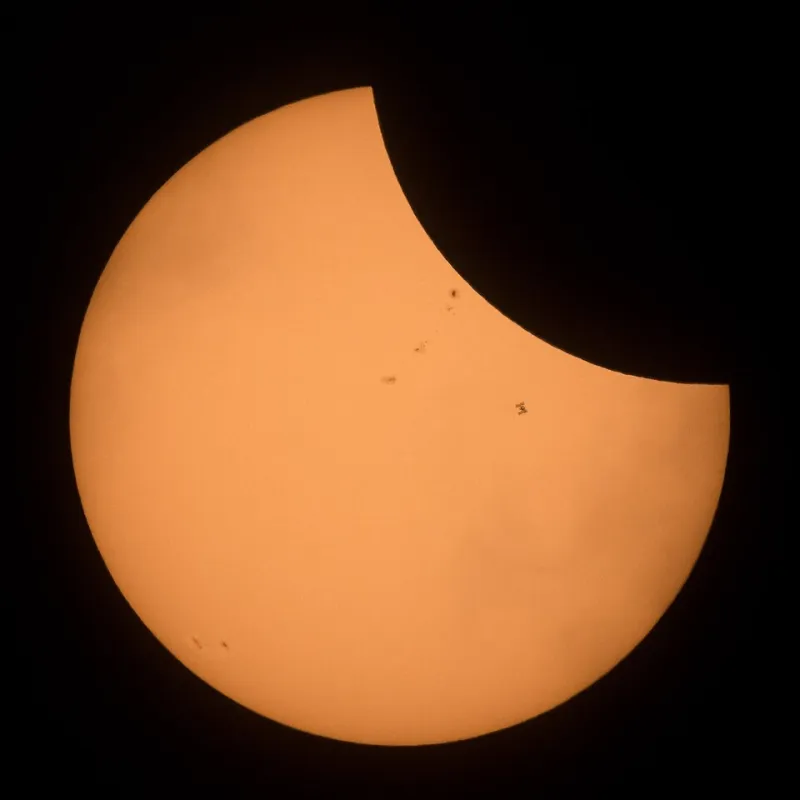
Photo: Joel Kowsky, CC BY 2.0, via Wikimedia Commons
There's a particular kind of obsession that grabs certain sky watchers and never really lets go. It's not enough to see the ISS glide overhead for eight or ten minutes — they want to catch it as a tiny black silhouette sliding across the face of the sun, or a crisp dark speck drifting over a full moon. The whole event might last three seconds. It might last six. Blink wrong and you've missed it entirely. But if you're standing in exactly the right spot? It's one of the most dramatic things the night sky — or the daytime sky — will ever show you.
These events are called solar transits and lunar transits, and they're genuinely underappreciated corners of the ISS-watching world. Let's break down why they happen, how to predict them, and how to get yourself under the path before the station zips across.
Why Transits Are So Rare (and So Precise)
The ISS orbits at roughly 250 miles above Earth, completing a lap every 90 minutes or so. On most passes, it arcs across your sky nowhere near the sun or moon — just a bright moving dot that fades into shadow or disappears below the horizon. A transit requires an almost absurdly specific alignment: you, the ISS, and either the sun or moon all have to be lined up within a fraction of a degree.
Because the station's orbital path is a narrow ribbon projected onto Earth's surface, a transit is only visible from a thin strip of ground called the center line, typically just a few miles wide. Move five miles perpendicular to that line and you'll watch the ISS pass just above or below the disk — close, but no cigar. The geometry is mercilessly precise.
Transit durations depend on the station's angular speed relative to the disk it's crossing. The sun and moon appear roughly the same size in our sky — about half a degree across — and the ISS tears across that width in anywhere from about 0.5 seconds (at a glancing angle) to around 1.5 seconds at the disk's widest point. Capture it at the center of the solar disk and you're looking at the longest possible crossing time, still measured in single-digit seconds.
The Math Underneath the Magic
Predicting a transit is a geometry problem layered on top of an orbital mechanics problem. Here's the simplified version:
- Get the station's ephemeris — its predicted position and velocity vector at any given moment, usually sourced from NORAD two-line element (TLE) data.
- Calculate the angular position of the ISS as seen from your coordinates at each moment in time.
- Compare that to the angular position and angular radius of the sun or moon.
- Find the time window when the ISS's angular position falls within the disk.
The tricky part is that TLE data degrades over time. The ISS regularly adjusts its orbit for debris avoidance or crew vehicle docking, so predictions made more than a few days out carry increasing error. For solar transits — where you'll be pointing a camera or telescope directly at the sun — even a one-second timing error matters enormously.
The center line itself is calculated by projecting the ISS's ground track forward and finding where, at each moment, the observer's line of sight to the station would pass through the center of the target disk. This produces a curved path across the landscape that might cross a highway, a cornfield, or the middle of Lake Michigan. You go where the math says.
Tools That Actually Do the Heavy Lifting
You don't need to run the orbital math yourself. A handful of specialized calculators handle it well:
Transit-Finder.com is the go-to resource for most serious transit chasers in the US. Enter your latitude, longitude, and a search radius (how far you're willing to travel), and it returns upcoming solar and lunar transit opportunities with center line coordinates, predicted times, and duration estimates. It updates regularly as fresh TLE data comes in.
CalSky (now partially mirrored through archival tools) was long considered the gold standard before it went offline. Its methodology still influences how modern calculators approach the problem.
Heavens-Above offers transit predictions as part of its broader ISS pass suite, though its transit-specific interface is less detailed than Transit-Finder.
For mobile users, ISS Detector (Android) includes transit prediction with a map overlay — genuinely useful for scouting your drive to the center line.
Step-by-Step: Planning Your First Transit Chase
Step 1: Check Transit-Finder weekly. Set your home coordinates and a travel radius — even 50 miles opens up significantly more opportunities. Transits cluster in certain seasons depending on your latitude.
Step 2: Note the center line coordinates. The calculator will give you GPS coordinates for the optimal viewing strip. Plug these into Google Maps and figure out if the spot is accessible. Parking lots, open fields, and rooftops all work. Private property obviously doesn't.
Step 3: Refresh predictions 24–48 hours before. New TLE data can shift the center line by miles. Don't drive three hours based on week-old predictions.
Step 4: Arrive early and set up. For solar transits, you need a properly filtered telescope or solar binoculars — never look at the sun without certified solar filtration. For lunar transits, a standard telescope or even a long telephoto lens works fine.
Step 5: Use a countdown timer synced to GPS time. Apps like Emerald Time or GPS Time keep you synchronized to the second. The ISS will not wait for you to fumble with a stopwatch.
Step 6: Record video, not single frames. At 60fps or higher, you'll capture multiple frames of the transit. At 1/1000s shutter or faster, each frame will be sharp. Review afterward — you'll know immediately whether you nailed it.
Real Examples Worth Studying
In April 2023, a solar transit visible from parts of the American Southwest was captured by several observers along a center line running through southern Utah. Duration: approximately 0.8 seconds. The resulting images — dark ISS silhouette against active sunspot regions — circulated widely in the amateur astronomy community.
Lunar transits, being easier to photograph (no filtration required, longer exposure flexibility), tend to produce even more dramatic images. A 2022 transit captured from rural Ohio showed the station's distinctive truss and solar array profile clearly resolved against a nearly full moon.
Upcoming opportunities in 2025 include multiple solar transit windows passing through the continental US — Transit-Finder is your best resource for current dates as TLE data evolves.
The Payoff
Chasing a transit is genuinely different from watching a standard ISS pass. There's route planning, gear prep, a drive to coordinates that might be a random roadside pullout in Kansas, and then a six-second window that either delivers or doesn't. When it delivers, the image you bring home is unlike anything else in amateur astronomy — the unmistakable shape of humanity's orbital outpost, tiny against the sun or moon, proof that the math worked and you were standing in exactly the right place at exactly the right moment.
That's worth a road trip.