The ISS Is a Gateway, Not the Destination: Overlooked Sky Events Worth Your Attention
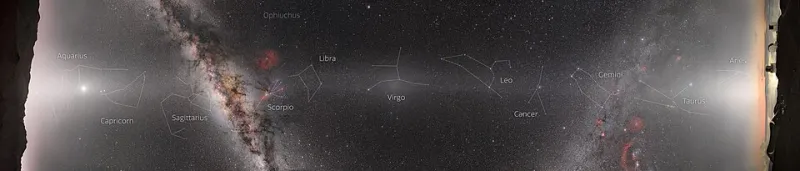
Photo: NOIRLab/NSF/AURA/ P. Horálek (Institute of Physics in Opava), T. Slovinský, CC BY 4.0, via Wikimedia Commons
Let's be honest about something: the International Space Station has done more to get ordinary Americans to look up at the sky than almost any other astronomical object in recent memory. It's bright, it's predictable, it moves in a way that feels almost personal — like it's crossing your yard specifically. That's genuinely wonderful. But here's the thing that doesn't get said enough in stargazing circles: if the ISS is the only thing you're tracking, you're leaving a remarkable amount of sky on the table.
This isn't a criticism. It's an invitation. Because the habits and tools you've built around ISS watching — checking coordinates, timing passes, understanding orbital geometry — translate directly into a much wider world of celestial events that are just as dramatic and far less crowded with other observers.
The Station as a Training Ground
Tracking the ISS teaches you things you might not realize you've learned. You've internalized azimuth and elevation. You know what it means for an object to rise in the west and cross the meridian. You've learned to read sky conditions quickly — is there enough transparency tonight? You've probably developed a feel for when the geometry is favorable and when it isn't.
All of that is real astronomical literacy. The ISS just happened to be the classroom. Now it's time to apply it elsewhere.
Asteroid Occultations: The Other Blink-and-Miss-It Event
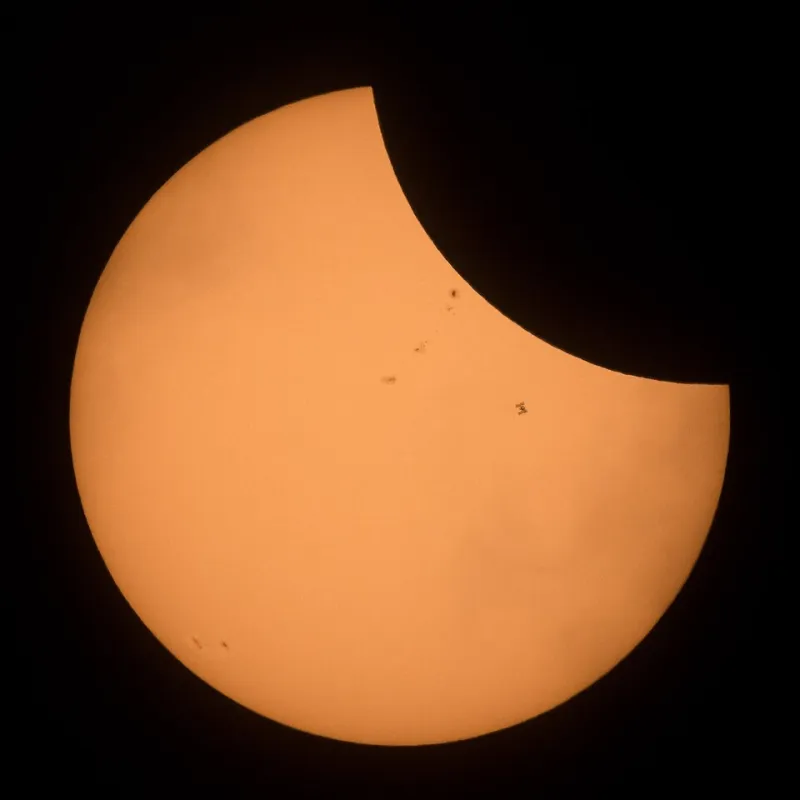
If you've ever chased an ISS transit (where the station crosses the sun or moon), you already understand the concept of occultations. When a minor planet — an asteroid — passes in front of a background star, that star winks out for a fraction of a second from a narrow strip of Earth's surface. The strip might be 30 miles wide. The blackout might last 0.3 seconds.
This sounds obscure. It's actually a big deal. Professional astronomers rely on amateur networks to time these events from multiple locations simultaneously, which lets them precisely measure the asteroid's size and shape. Your timing data, collected from your driveway in Ohio, contributes to peer-reviewed science.
The International Occultation Timing Association (IOTA) maintains a database of upcoming events at occultations.org, with predictions down to your specific coordinates. The equipment requirements are modest: a telescope, a video camera or webcam, and a GPS-synchronized time source. Sound familiar? It's basically the same setup as a lunar transit chase.
Iridium Flares — Gone, But Not Entirely Forgotten
The original Iridium satellite constellation produced legendary flares — predictable, brilliant bursts reaching magnitude -8 or brighter as their flat antenna panels caught the sun at just the right angle. The replacement Iridium Next satellites don't flare the same way, and many observers mourned the loss.
But specular reflections from satellites haven't disappeared entirely. Several older or tumbling satellites still produce unpredictable bright flares. More usefully, the Starlink constellation produces its own reflection events — not as dramatic as classic Iridium flares, but visible and trackable. Heavens-Above and Stellarium's satellite module both flag predicted flares from currently active satellites. If you're already checking pass times, it takes thirty extra seconds to check for flares on the same pass.
Polar Stratospheric Clouds: Winter's Weirdest Spectacle
Here's one that has nothing to do with orbital mechanics and everything to do with being outside and looking up. Polar stratospheric clouds (PSCs) form at altitudes around 15–25 kilometers during extreme cold events in the lower stratosphere. They're iridescent — shimmering in pastel blues, pinks, and greens — and they appear just before sunrise or just after sunset when lower clouds are in shadow but stratospheric altitudes are still catching sunlight.
In the continental US, PSCs are rare but not unheard of, particularly in the northern tier states during January and February. Alaska sees them more regularly. When they appear, they're otherworldly — and they're easy to miss if you only go outside to check ISS pass times and immediately go back in.
The habit of being outside during twilight — which ISS chasers develop naturally, since many passes happen at dusk and dawn — puts you in exactly the right position to catch PSCs when they occur.
Airglow: The Sky That Glows for No Obvious Reason
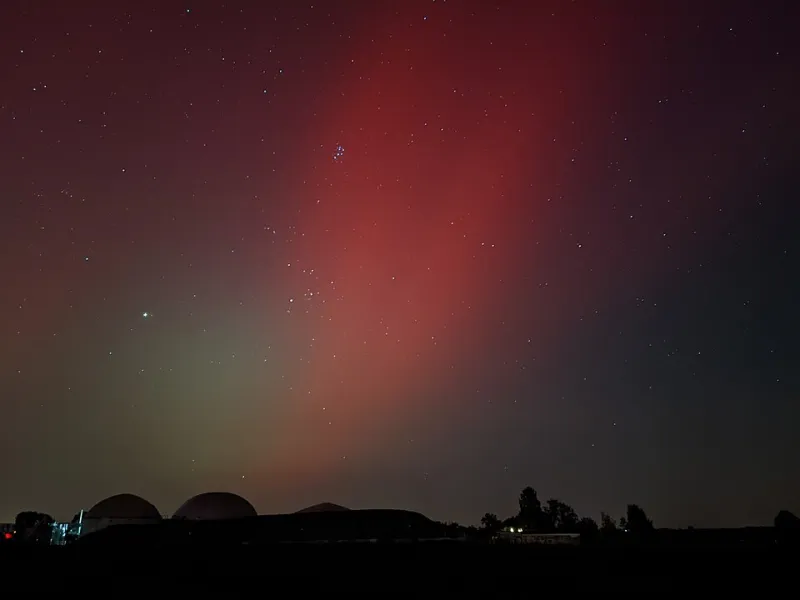
On a truly dark night, away from city lights, the sky itself emits a faint, diffuse glow. This is airglow — chemiluminescence produced when solar radiation energizes molecules in the upper atmosphere during the day, and those molecules release that energy as light at night. It's usually greenish at around 90 kilometers altitude, though red and blue variants exist at different heights.
Airglow is invisible to the naked eye under most conditions, but a wide-angle camera on a dark-sky night will reveal it in long exposures. ISS photographers who've moved beyond phone cameras and started using DSLRs or mirrorless systems on tripods often capture airglow without realizing what they're seeing — a faint rippling structure across the sky background.
Once you know what to look for, it becomes part of every dark-sky session. It's the atmosphere reminding you it's alive.
Naked-Eye Planets and Conjunctions: The Underrated Calendar
Planetary conjunctions — when two or more planets appear close together in the sky — happen several times a year and require zero equipment. A Saturn-Jupiter conjunction is striking with the naked eye and stunning through even a modest telescope. Venus at maximum elongation is bright enough to cast a faint shadow on a dark night.
NASA's Sky Events Calendar and Sky & Telescope's almanac section both maintain running lists of upcoming conjunctions, elongations, and oppositions. These events are predictable months in advance — far more stable than ISS pass predictions, which shift daily. Adding them to your observing calendar costs nothing and pays off regularly.
Building a Broader Observing Practice
Here's a practical suggestion: the next time you step outside for an ISS pass, give yourself an extra fifteen minutes before and after. Check what planets are up. Look for airglow structure in your camera's live view. Note whether any bright stars are near the moon — an occultation might be in the forecast. Let the pass be one item on a richer agenda rather than the entire program.
The ISS is genuinely spectacular. It's real hardware, real people, real science, crossing your sky at 17,500 miles per hour. But it orbits within a universe that's stacked with wonders at every scale — from a millisecond asteroid blink to the slow shimmer of the stratosphere in winter twilight.
You already have the skills. The sky has more to show you than you've asked for yet.