The Graveyard Overhead: Tracking Earth's Orbital Ghost Fleet
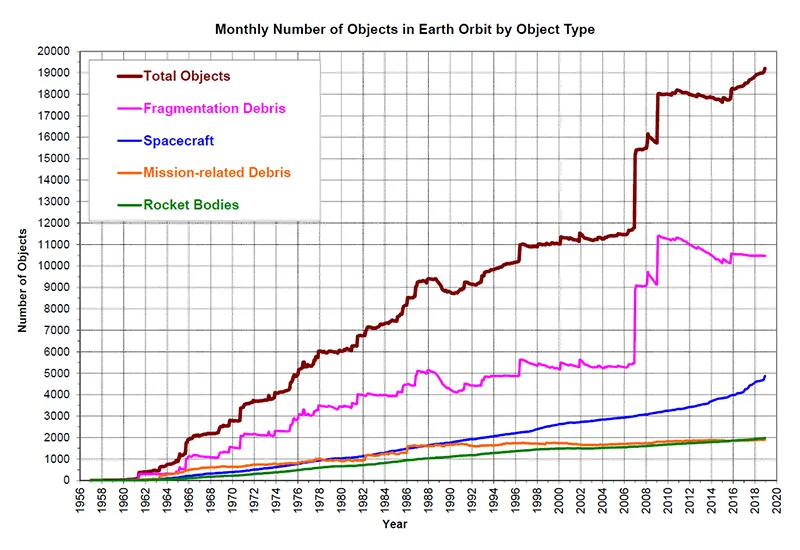
Photo: NASA: ODPO, Public domain, via Wikimedia Commons
That Moving Light Isn't Necessarily Alive
You step outside on a clear night, tip your head back, and catch a steady point of light drifting silently from horizon to horizon. Your first instinct is probably to think: spacecraft. And technically, you're right — it is an object in space. But there's a decent chance what you're watching is closer to a ghost than a living machine.
Earth orbit is a junkyard. A spectacular, physics-defying junkyard, but a junkyard nonetheless. Alongside active stations like the ISS and operational satellites doing real work every day, our planet is encircled by thousands of objects that are simply... done. Dead satellites tumbling slowly in the dark. Spent rocket upper stages that burned their fuel decades ago and never came home. Fragments of hardware from collisions and explosions that happened before some of you were born. All of it trackable. Much of it visible.
For backyard sky watchers, this opens up a genuinely fascinating layer of observation that most people never think to explore.
What's Actually Up There
The U.S. Space Surveillance Network currently tracks roughly 27,000 objects in Earth orbit large enough to catalog — meaning anything approximately the size of a softball or bigger. Of those, fewer than 10,000 are active satellites. The rest? Debris, defunct hardware, and spent propulsion stages.
Breaking that down a little further:
Defunct satellites are the most common large objects. These are spacecraft that completed their missions, ran out of fuel, suffered hardware failures, or were simply switched off when they became obsolete. Some have been up there for 40 or 50 years. The Vanguard 1 satellite, launched in 1958, is the oldest human-made object still in orbit — and it stopped transmitting in 1964. It'll probably stay up there for another 200 years.
Spent rocket bodies are the upper stages left over after launch vehicles delivered their payloads. These are often the brightest trackable objects after the ISS itself, because they're large and tumble unpredictably, causing dramatic brightness fluctuations as they catch sunlight at different angles. Watching a spent rocket stage flash from dim to brilliant and back again in the span of a few seconds is genuinely one of the more striking things you can see with the naked eye.
Fragmentation debris comes from collisions and intentional or accidental explosions. The 2009 collision between Iridium 33 and Cosmos 2251 — the first accidental hypervelocity collision in history — created over 2,000 trackable fragments. China's 2007 anti-satellite test added another 3,500. Most of this debris is too small to observe visually, but some larger chunks are cataloged and trackable.
Why Any of This Matters to You as an Observer
Beyond the pure novelty factor, there are a few solid reasons to pay attention to the orbital graveyard.
First, it's a genuine history lesson. When you track an old Soviet-era satellite or a spent Centaur upper stage from the Apollo era, you're watching physical evidence of specific moments in human history drift overhead. That's a different kind of sky watching than just logging ISS passes.
Second, the brightness behavior of defunct hardware is often more dramatic and unpredictable than active satellites. Tumbling rocket bodies can produce what observers call "flares" — rapid, repeating brightness spikes that look almost strobe-like through binoculars. These aren't the smooth, steady transits of the ISS. They're chaotic and kind of beautiful.
Third, if you're interested in the bigger picture of space sustainability and orbital crowding, actually watching this stuff go overhead gives you a visceral appreciation for what researchers and policymakers are worried about. Reading about debris risk is one thing. Watching a decades-old dead satellite pass over your backyard in suburban Ohio is another.
How to Find and Identify Non-Operational Objects
The good news: the tools you probably already use for ISS tracking work just as well for debris and defunct satellites.
Heavens-Above.com is arguably the best free resource for this. It pulls data directly from the U.S. Space Surveillance Network's two-line element sets (TLEs) and lets you generate pass predictions for a massive catalog of objects — not just the ISS. You can specifically search for rocket bodies, look up individual satellites by name or NORAD catalog number, and filter by brightness.
Stellarium (the desktop or web version) can be loaded with satellite databases and will show you tracked objects overlaid on a real-time sky map. It's a great way to visualize passes before you head outside.
Space-Track.org is the official U.S. government source for orbital data and is free to use with a registered account. It's more technical, but if you want raw TLE data or want to look up the history of a specific object, it's the authoritative source.
When you're out observing, here's a practical tip for distinguishing active satellites from dead hardware: active satellites almost always maintain a steady, consistent brightness because they're stabilized and attitude-controlled. Defunct objects — especially rocket bodies — frequently tumble, producing that distinctive flashing or pulsing effect. If something is blinking at you rhythmically as it crosses the sky, there's a good chance it's not in active service.
A Few Objects Worth Hunting
If you want somewhere to start, here are a handful of specific objects that are frequently visible from the continental US and have interesting backstories:
SL-16 rocket bodies — Upper stages from Soviet and Russian Zenit rockets. These are large, bright, and many are still in relatively stable orbits. They tumble noticeably.
Vanguard 1 (1958 Beta 2) — The oldest object in orbit. It's faint (around magnitude 9, so you'll need binoculars), but tracking it down is a legitimate bucket-list observation for space history enthusiasts.
NOAA-16 — A defunct weather satellite that suffered a catastrophic failure in 2015 and broke into dozens of tracked fragments. The main body is still cataloged and occasionally visible.
Cosmos 954 — A Soviet satellite with a nuclear reactor onboard that partially reentered over Canada in 1978. Parts of it are still up there.
Each one of these has a story. That's the thing about the orbital graveyard — it's not just clutter. It's a museum.
The Bigger Picture
There's something almost meditative about going outside on a quiet night and watching a piece of hardware that launched before you were born slowly arc over your rooftop. It's been up there through wars, elections, technological revolutions, and generational change — just quietly circling, indifferent to all of it.
The night sky isn't just a window to the cosmos. For anyone paying attention, it's also a record of human ambition, engineering achievement, and — honestly — a fair amount of accumulated mess. Learning to read that record is one of the more underrated skills in amateur astronomy.
So next time you're out tracking passes, don't just watch for the ISS. Scroll through the catalog. Find something old. Find something tumbling. Watch it cross the stars and think about where it came from and what it represents.
The graveyard overhead is open for tours, and admission is free.